
HOW TO WRITE A PRESS RELEASE THAT GETS RESULTS
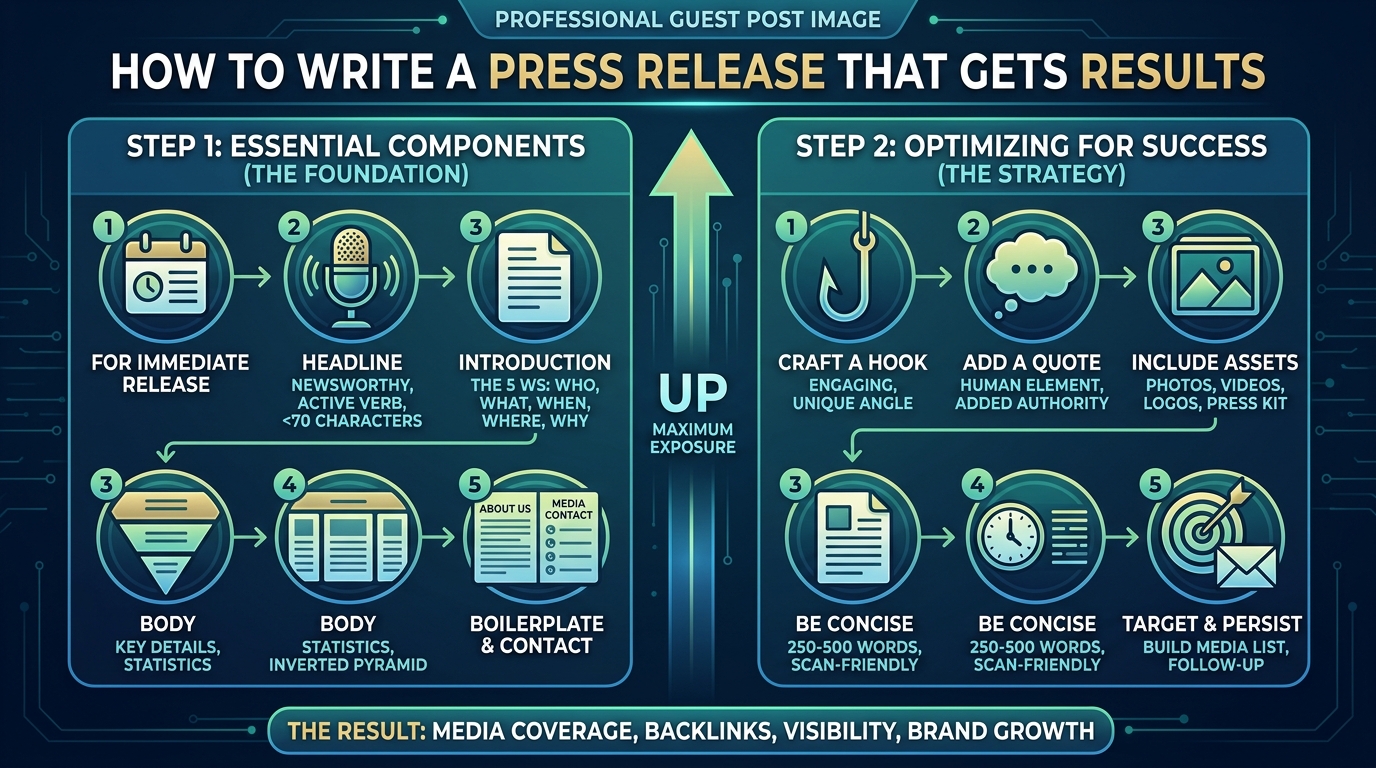
Press releases have changed significantly over the years. They are no longer limited to printed announcements delivered to newspaper offices. Today, a press release can reach journalists, online publications, industry professionals, local communities, and members of the public through digital channels.
That wider reach creates an opportunity, but it also creates a challenge. Readers see a large amount of content every day, and journalists receive many announcements competing for attention. A press release therefore needs to communicate its value quickly.
The strongest releases are not necessarily the longest or most dramatic. They are the ones that present a legitimate news story in a clear, accurate, and useful way.
What Makes a Press Release Newsworthy?
Before writing a single paragraph, identify the actual news.
A company may be proud of a new website, office renovation, or internal process. That does not automatically mean the development deserves a press release.
A stronger story might involve a major expansion, a new research finding, a significant partnership, a leadership appointment, a public initiative, or an event that affects a particular community.
One useful test is to ask:
Would someone who does not work for this organization find this information interesting or useful?
If the answer is no, the announcement may need a stronger angle.
Newsworthiness can come from several factors, including timing, location, public interest, scale, relevance, and impact. A relatively small event can still become a strong local story if it directly affects people in the community.
Identify the Main Message
Once you have a news angle, reduce it to one clear idea.
For example:
"A healthcare nonprofit is opening a free clinic in a rural county."
That sentence gives you a foundation for the entire release.
You can then build around questions such as:
- When will the clinic open?
- Where will it be located?
- Who can use it?
- What services will be available?
- Why was the clinic created?
- How was the project funded?
- What do local officials or community leaders say about it?
This approach prevents the release from becoming a collection of unrelated company information.
Write a Headline That Communicates the News
The headline should make the subject immediately clear.
Weak headlines often rely on vague promotional language:
"Company Unveils Exciting New Initiative"
There is no clear story in that sentence.
A stronger alternative could be:
"Atlanta Organization Opens Free Career Center for Unemployed Workers"
The reader now knows the location, organization type, action, and intended audience.
A good headline should be specific without becoming unnecessarily long. It should also avoid claims that cannot be supported.
Words such as "revolutionary," "unmatched," and "best" may attract attention for a moment, but they often make a news release sound like advertising.
Get to the Point in the Lead
The first paragraph is one of the most important parts of the release.
Journalists often scan information quickly, so the lead should provide the central facts without a long introduction.
A useful lead can answer the basic questions of who, what, when, where, why, and how.
For example:
"Phoenix-based environmental group Desert Water Watch announced Tuesday that it will begin a year-long program to monitor water quality at 25 sites across central Arizona."
The reader immediately understands the main development.
The next paragraphs can explain the reason for the program, how monitoring will take place, and what the organization hopes to learn.
Use the Inverted Pyramid Structure
Traditional news writing often follows the inverted pyramid. The most important information comes first, followed by supporting details and background.
This structure works well for press releases because it respects the reader's time.
A simple order is:
Main announcement → important facts → quote → additional details → background
Do not hide the most important information near the end of the release.
If a journalist only reads the first two paragraphs, they should still understand what the announcement is about.
Include Evidence Where It Matters
A credible press release separates facts from opinions.
Suppose an organization claims that a new program will "dramatically improve access to education." That statement is difficult to evaluate without supporting information.
A better approach is to explain what the program does and provide relevant evidence.
For example:
"The program will provide free tutoring to 500 middle-school students during the 2026–27 school year, with sessions offered at eight public libraries."
This gives readers concrete information.
Research findings, survey results, government statistics, public records, and clearly identified organizational reports can all help provide context when appropriate.
However, statistics should never be added simply to make a release appear more authoritative. Every figure should be accurate, relevant, and presented honestly.
Write Quotes That Add Something New
A quote is an opportunity to provide interpretation or a human perspective.
It should not simply repeat information already stated in the release.
Compare:
"We are excited to announce our new program," said the company's CEO.
with:
"We designed the program around evening hours because many of the families we serve work during the day," said the program director.
The second quote tells the reader something meaningful.
Good sources for quotes can include executives, researchers, project leaders, community representatives, partners, or other people with direct knowledge of the announcement.
The person quoted should also be identified accurately, including their current title and organization.
Explain Technical Information Clearly
Many press releases cover subjects that involve specialized terminology.
Technology, finance, science, manufacturing, healthcare, and other technical industries often use words that are familiar to professionals but confusing to general readers.
The solution is not to remove all technical language. Instead, explain necessary terms when they first appear.
For example, rather than assuming readers understand a specialized technology, briefly describe what it does and why it matters.
This makes the release accessible to a broader audience while preserving accuracy.
Clear writing is particularly important when a press release may be republished online or referenced by people outside the organization's industry.
Think Carefully About Press Release Distribution
A well-written announcement can still underperform if it reaches the wrong audience.
Press Release Distribution should be based on relevance rather than simply the number of outlets reached.
Start by identifying the publications and journalists most likely to care about the subject.
A local business opening may be relevant to local news organizations, business publications, and community websites. A new software research finding may be more appropriate for technology or industry publications.
Geography also matters. An announcement about a project in Ohio may have strong regional relevance even if it has little reason to attract national coverage.
Timing is another consideration. A release about an event should generally be distributed with enough notice for journalists to plan coverage. A response to breaking news, on the other hand, may require much faster communication.
The goal is to put useful information in front of people who have a genuine reason to care about it.
Avoid Turning the Release Into an Advertisement
One of the easiest ways to weaken a press release is to make it sound like a sales page.
Statements such as "our incredible service is the best solution available" do not provide much useful information.
Instead, explain what the organization has done, who it affects, and what evidence supports its claims.
A factual tone can actually make an announcement more persuasive because readers can form their own conclusions.
This does not mean an organization should hide its accomplishments. Important milestones, awards, growth figures, research results, and other achievements can be included when they are genuinely relevant to the story.
The difference is presentation.
News explains. Advertising persuades.
A press release should lean toward the first.
Make the Organization Easy to Understand
At the end of the release, include a short boilerplate describing the organization.
This section does not need to tell the company's entire history.
A useful boilerplate might explain:
- What the organization does
- Where it is based
- What industry or field it serves
- When it was established, if relevant
- Where readers can find official information
Keep it factual and concise.
Avoid filling the boilerplate with unsupported descriptions such as "America's leading" or "the nation's premier" unless there is a legitimate basis for the claim.
Include Accurate Contact Information
A journalist who wants additional information should be able to contact the appropriate person.
Include a relevant media contact and verify that the contact information is current.
Depending on the announcement, journalists may want access to additional photographs, reports, research documents, interview opportunities, or official statements.
Providing accurate information makes follow-up easier.
Use Links With a Purpose
Online press releases often contain links, but every link should have a reason to exist.
A link to a research report can allow readers to examine the evidence behind a claim. A link to an event page can provide dates and registration information. An official company page can offer additional background.
Avoid adding links simply to repeat keywords.
A useful rule is simple: if a reader clicks the link, will they receive information that genuinely helps them understand the story?
If not, the link may not be necessary.
Consider Search Visibility Without Keyword Stuffing
Search engines can help people discover press releases long after the original announcement.
That makes natural keyword use worthwhile. Include important terms where they accurately describe the story, but do not force them into every paragraph.
For example, if the release concerns a new workforce training program in California, terms related to workforce training, the location, and the specific program may naturally appear.
There is no need to repeat the same phrase dozens of times.
Readable content should come first.
Check Every Fact Before Publication
Accuracy is central to trust.
Before releasing the announcement, verify:
- Names and titles
- Dates and times
- Locations
- Statistics
- Company names
- Quotations
- URLs
- Research references
- Product or project names
If several people contributed to the release, give relevant stakeholders an opportunity to verify factual information.
Be especially careful with projections. A prediction about future revenue, hiring, expansion, or impact should be clearly presented as a forecast rather than a confirmed result.
Learn From the Results
After publication, review what happened.
Depending on the purpose of the announcement, useful measures may include media coverage, journalist inquiries, referral traffic, interviews, mentions by relevant publications, or public engagement.
Do not judge every press release by the same measurement.
A local announcement may succeed if it earns coverage in two influential regional publications. A national research announcement may have a different goal.
The important question is whether the release reached an appropriate audience and generated meaningful attention.
A Practical Press Release Checklist
Before distributing the final document, ask:
- Does the announcement contain genuine news?
- Is the headline specific?
- Does the lead explain the main development?
- Are the most important facts near the beginning?
- Are claims supported by evidence?
- Does the quote add useful context?
- Is the language simple?
- Have promotional statements been removed?
- Are names and statistics accurate?
- Are links relevant?
- Is the boilerplate concise?
- Can journalists easily contact someone for more information?
- Is the distribution audience appropriate?
If several answers are no, revise the release before sending it.
Final Thoughts
A press release does not need exaggerated language to get results. In many cases, the opposite is true.
The most useful releases are built around genuine news and written with respect for the reader. They provide important facts early, use evidence responsibly, include meaningful quotes, and avoid unnecessary promotion.
Good distribution then connects that information with journalists and audiences who are most likely to find it relevant.
The basic principle is simple: write a press release as a useful piece of news, not as an advertisement disguised as one.
When the story is clear, the facts are reliable, and the audience is carefully considered, the release has a stronger chance of earning attention and contributing to meaningful media coverage.