
INDICAONLINE POS MARYLAND GUIDE TO HIGH-POTENCY SALE BLOCKS
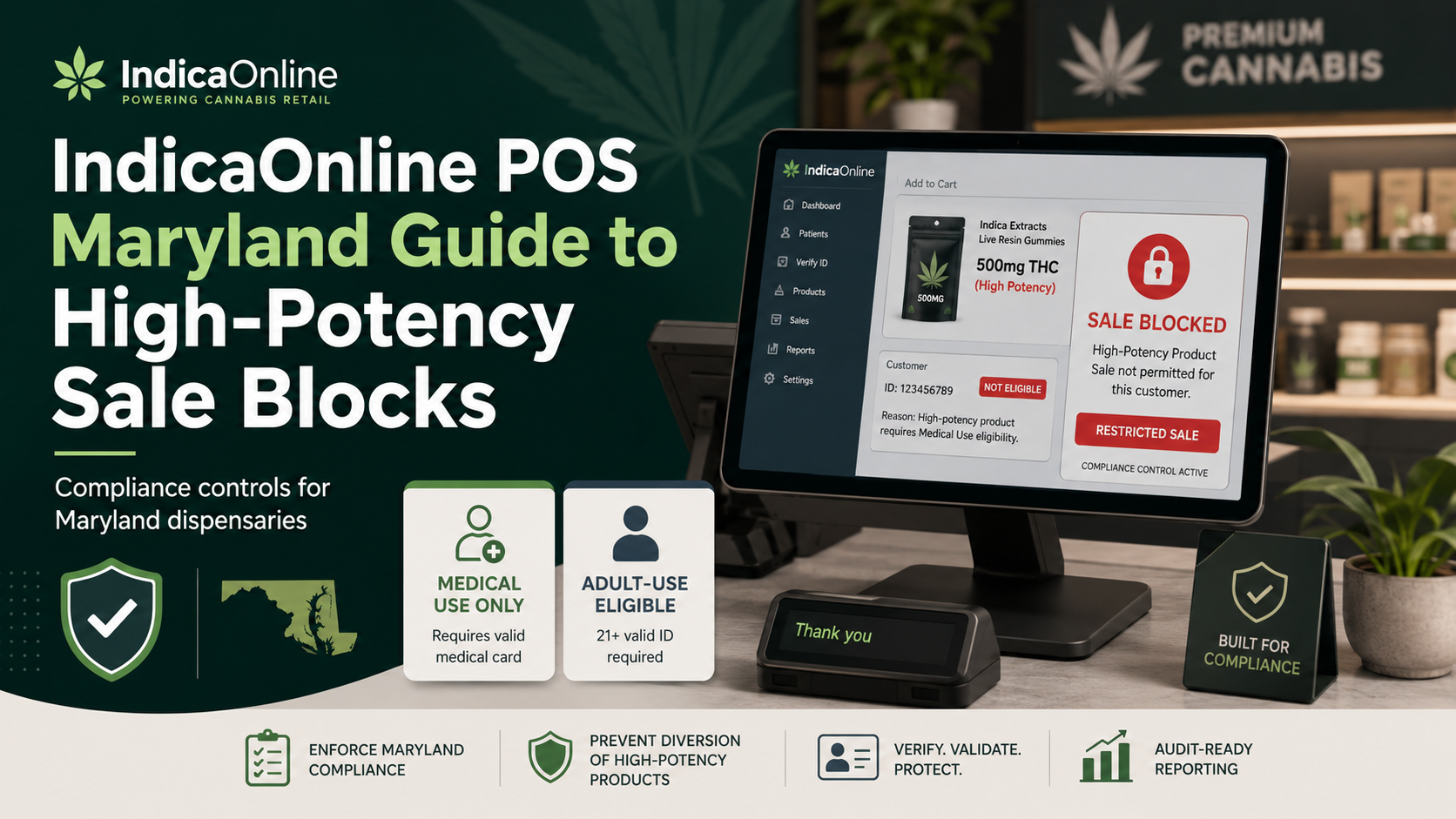
High-potency cannabis creates a specific checkout challenge for Maryland dispensaries. A product can be legal for the store to carry and still be restricted to qualifying medical patients or registered caregivers. If the POS treats every customer and SKU the same way, staff may be forced to remember eligibility rules during a busy shift.
For retailers using IndicaOnline dispensary software in Maryland, high-potency sale blocks can turn those rules into a repeatable checkout control. The safest workflow identifies the customer type, checks the product’s category and potency, and stops an ineligible sale before payment is completed.
Maryland Cannabis Administration guidance requires dispensaries to reserve certain high-potency products for medical patients. Current guidance limits some concentrates and higher-dose edibles, capsules, and tinctures to qualifying patients and registered caregivers.
What a High-Potency Sale Block Does
A sale block is a POS rule that prevents an item from being completed in a transaction when the customer is not eligible to purchase it.
The control can evaluate:
- customer type;
- product category;
- total product weight;
- THC per serving;
- THC per package;
- medical-only status.
The purpose is not to slow checkout; it is to make the eligibility decision consistently every time.
Know Which Maryland Products Need Medical-Only Treatment
Maryland’s dispensary guidance states that medical-only products include concentrated cannabis products weighing more than 1 gram, subject to stated exceptions, plus edibles, capsules, and tinctures containing more than 10 mg THC per serving or more than 100 mg THC per package. Adult-use consumers may buy concentrates of 1 gram or less, vaporizing devices of any product weight, usable cannabis, infused non-edible products, and edibles, capsules, or tinctures that remain within the applicable limits.
Do Not Reduce the Rule to “High THC”
The restriction is not a single THC percentage cutoff across every category. Product form, serving size, package potency, and concentrate weight all matter.
A POS rule should reflect the actual product category and threshold instead of relying on a generic “high potency” label.
Classify Products Correctly Before Checkout
Sale blocks depend on good product data. A Maryland dispensary POS platform should maintain reliable fields for:
- product type;
- package size;
- serving size;
- THC per serving;
- total THC per package;
- concentrate weight;
- medical-only eligibility.
If a 200 mg edible is mistakenly configured as a 100 mg package, the checkout rule may allow the wrong customer to purchase it. Catalog accuracy is part of compliance.
Separate Customer Type From Age Verification
Age verification confirms that an adult-use customer is at least 21. Medical eligibility is a different control.
A shopper can be old enough for adult-use cannabis but still be ineligible for a medical-only product. For medical transactions, Maryland requires patients to present valid government-issued photo identification and their medical patient ID card or ID number, and the dispensary verifies certification before the transaction.
A cannabis POS for Maryland dispensaries should therefore distinguish:
- adult-use age eligibility;
- medical patient or caregiver status;
- current medical certification;
- product eligibility.
Passing an age check should never automatically unlock medical-only inventory.
Apply the Block Before Payment
The best place to enforce eligibility is while the cart is being built.
If an adult-use customer selects a restricted item, the POS can:
- identify the product as medical-only;
- stop it from being finalized;
- explain why it is restricted;
- allow staff to offer an eligible alternative;
- preserve the exception for review.
This is better than discovering the problem after payment authorization or inventory deduction.
Use Clear Employee Messages
A generic “Item Not Allowed” warning creates confusion. A stronger message might say: “Medical-only product: potency exceeds adult-use limit.”
A compliance warning should tell the employee what to do next, not just that something went wrong.
Restrict Manual Overrides
High-potency restrictions should not be easy for front-line staff to bypass. POS software for Maryland cannabis retailers can use role-based permissions so budtenders cannot simply override a medical-only flag.
If an exception workflow exists, it should capture:
- employee;
- manager;
- date and time;
- product;
- reason;
- final resolution.
An override should be treated as an exception requiring investigation, not as an ordinary checkout shortcut.
Keep Medical-Only Products Visible to the Right Customers
Sale blocks also affect ecommerce. If medical-only inventory appears to every adult-use shopper as freely purchasable, customers may build carts that cannot be completed.
A cannabis retail platform for Maryland can use customer type or menu logic to:
- label medical-only products;
- restrict them from adult-use menus where appropriate;
- prevent ineligible reservations;
- preserve inventory for medical patients.
Maryland guidance requires dispensaries to maintain adequate medical product supply and reserve specified high-potency products for patients.
Eligibility should be considered before checkout, not only at the final register screen.
Watch for Product Data Changes
Potency information can change when a new batch or package of the same retail SKU arrives. The product name may stay the same while the underlying package changes.
Managers should review:
- new package mappings;
- updated COA data;
- serving-size changes;
- total package THC;
- concentrate weights;
- medical-only flags.
The SKU name alone is not enough to determine eligibility.
Connect Sale Blocks With Metrc and Inventory
A Metrc-compliant POS for Maryland should tie sale eligibility to the correct package. Similar SKUs should not become interchangeable when one package is medical-only and another is adult-use eligible.
Build a High-Potency Control Checklist
Before Products Go Live
- classify the product correctly;
- verify concentrate weight;
- verify THC per serving and package;
- set the correct medical-only flag;
- test the sale rule.
During Checkout
- verify customer type;
- honor the sale block;
- avoid manual workarounds;
- escalate unexpected messages.
During Weekly Review
- examine blocked-sale reports;
- review overrides;
- check newly received high-potency items;
- confirm ecommerce eligibility.
Use Current MCA Guidance as the Baseline
Maryland’s latest dispensary guidance states that certain high-potency products must be reserved for medical patients and caregivers. It identifies concentrates above 1 gram and edibles, capsules, and tinctures above 10 mg THC per serving or 100 mg THC per package as restricted categories, with specific product exceptions described by MCA.
Retailers should review the Maryland Cannabis Administration dispensary guidance when configuring product eligibility and sale-block rules.
Final Takeaway
Maryland’s dual medical and adult-use market makes high-potency product eligibility an important POS control.
The strongest sale-block workflow combines accurate product classification, verified customer type, package-level data, role-based permissions, and clear checkout warnings. When those controls work together, dispensaries can protect medical-only inventory and prevent ineligible high-potency sales without asking budtenders to memorize every threshold.