
MISSOURI DISPENSARY POS GUIDE TO ADDITIVE RECORD ACCURACY
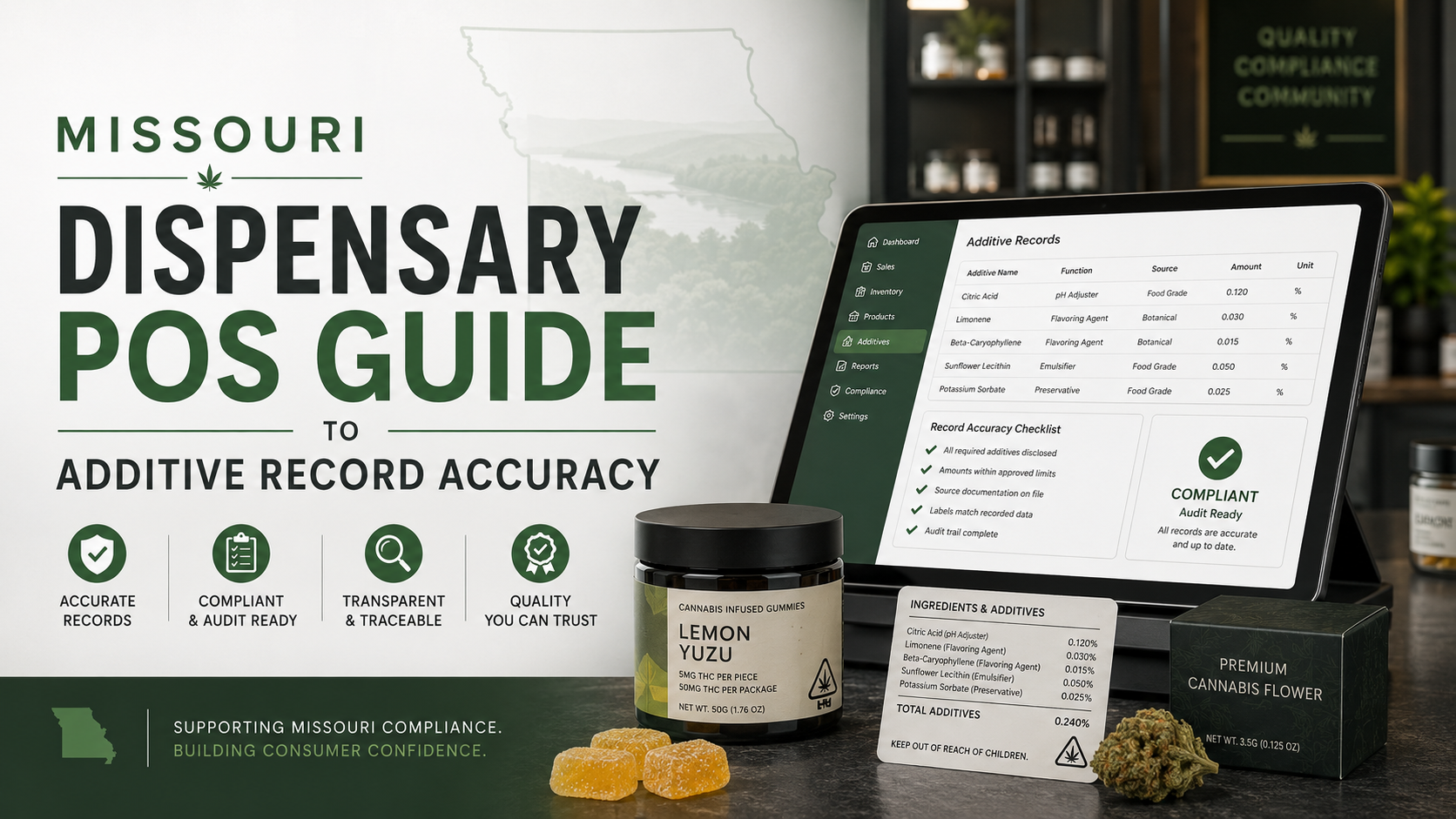
Ingredient and additive data may seem like manufacturing information, but it follows a cannabis product all the way to the dispensary shelf. In Missouri, final product records and labels are expected to identify active and other ingredients accurately. If the POS catalog, package label, and statewide track-and-trace record do not agree, the retailer may inherit a data-quality problem it did not create.
For retailers using cannabis POS for Missouri dispensaries, additive record checks can become part of receiving and catalog management. The goal is to make sure the product sold at checkout is linked to the same ingredient information that supports its regulated item record and physical label.
Missouri rules require manufacturing licensees to record all active and inactive ingredients in each final manufactured product in the statewide track-and-trace system. Product labels must also list active and other ingredients and include solvents used in manufacturing.
Why Additive Record Accuracy Matters
A dispensary usually receives finished inventory, but it remains the final checkpoint before the product reaches a patient or consumer.
Inaccurate additive data can create problems with:
- package and catalog consistency;
- customer-facing product information;
- label reviews;
- supplier investigations;
- recalls or compliance checks.
A retailer should not assume that a product record is correct simply because the package arrived through an approved transfer.
Understand Missouri Ingredient Requirements
Missouri's labeling rule requires final marijuana product labels to disclose all active and other ingredients. Ingredient groupings should not obscure the actual ingredients, and solvents used in manufacturing must be included.
Manufacturing licensees must also record active and inactive ingredients for each final manufactured product in the statewide track-and-trace system.
For a Missouri dispensary POS platform, the practical question is simple:
Does the retail product record correspond to the regulated item and the ingredient information printed on the package?
Know the Flavoring Variance for Ingestible Products
Missouri has an important exception for ingestible marijuana-infused products. DCR allows components of natural and artificial flavorings to be grouped using descriptions such as a named flavoring rather than listing every proprietary flavor component individually.
That variance does not extend the same treatment to products intended to be smoked or vaporized. DCR specifically notes that inhaled flavoring additives can present different concerns.
Apply the Right Rule to the Right Product
Staff should confirm:
- product type;
- method of administration;
- whether the product is ingestible or inhaled;
- which ingredient disclosure rule applies.
A valid exception for one category should not become a shortcut for every category.
Check Additive Data During Receiving
Receiving is the strongest retail control point because inventory has not yet been released to customers.
When a finished product arrives, staff can compare:
- package label;
- regulated item or package data;
- POS SKU;
- ingredient information;
- product type;
- item approval information where relevant.
If the label appears inconsistent with the expected product record, the SKU should enter review rather than immediately become sellable.
Validate New Batches Instead of Copying Old Records
A product may return from the same supplier with the same brand name but a changed formulation. Flavoring, carrier oil, terpene blend, sweetener, coloring, or another inactive ingredient may differ.
If staff simply copy the previous SKU configuration, the catalog may display outdated data.
A Metrc-compliant POS for Missouri should help connect each incoming package to the correct regulated item rather than treating every package with the same marketing name as identical.
The SKU can stay familiar while the formulation changes underneath it.
Watch for Humidity Control Packets
Missouri DCR issued a March 4, 2026 variance allowing humidity control packets in final marijuana product packaging under specified conditions. Licensees using them must keep documentation showing the packets are made from FDA-approved food-contact substances and note their inclusion in the applicable item approval information. DCR also warns that packets added after sampling can introduce contamination not captured by mandatory testing.
For retailers, receiving procedures should recognize when such packets are part of the approved packaged product.
Review POS-to-Metrc Consistency
Missouri requires licensees to ensure the accuracy of statewide track-and-trace information daily. Errors must be corrected promptly, with detailed notes explaining the error and corrective action.
Managers should investigate when:
- the POS item references the wrong regulated item;
- ingredient information appears outdated;
- a supplier changed the formulation;
- an integration imported incomplete data.
Integration moves data; it does not guarantee that every field is correct.
Restrict Ingredient and Additive Edits
Budtenders generally should not need permission to edit compliance-sensitive product fields.
POS software for Missouri cannabis retailers can restrict changes to inventory managers, compliance staff, or authorized administrators.
A useful audit history should preserve the previous value, new value, user, timestamp, and reason for the change.
Correcting ingredient data should create a traceable history instead of silently replacing the old value.
Build an Exception Workflow
Not every mismatch means the product is unlawful, but unresolved inconsistencies deserve review.
A practical process can be:
- Stop the affected SKU from being released.
- Confirm the package and item identity.
- Compare the physical label with regulated records.
- Contact the supplier when necessary.
- Document the explanation or correction.
- Restore sale status only after the mismatch is resolved.
Useful internal statuses include Ingredient Mismatch, Label Review, Supplier Confirmation Needed, and Sale Hold.
Create a Routine Additive Record Audit
At Receiving
- verify product identity;
- compare label ingredients;
- confirm the regulated item;
- review formulation changes;
- hold unexplained mismatches.
After Catalog Changes
- check package mapping;
- confirm product type;
- review ingredient fields;
- test ecommerce display where applicable.
Use Missouri DCR Guidance as the Baseline
Retailers should build ingredient and additive controls around current Missouri rules rather than generic labeling practices from another state.
The official Missouri DCR Licensee Communications & Guidance page collects current packaging, labeling, item approval, testing, inventory, and variance resources for licensees.
Missouri's rules also make the statewide track-and-trace system the system of record and require manufacturing licensees to record active and inactive ingredients in final manufactured products.
Final Takeaway
Additive record accuracy is primarily created upstream, but dispensaries are the last business in the supply chain before the product reaches the customer.
The strongest Missouri dispensary workflow keeps the package label, regulated item, ingredient record, POS SKU, and customer-facing product information aligned. When those records disagree, the store should investigate the mismatch before sale instead of allowing inconsistent data to become part of normal operations.