
CANNABIS POINT OF SALE CONTROLS FOR ZERO-PRICE TRANSACTIONS
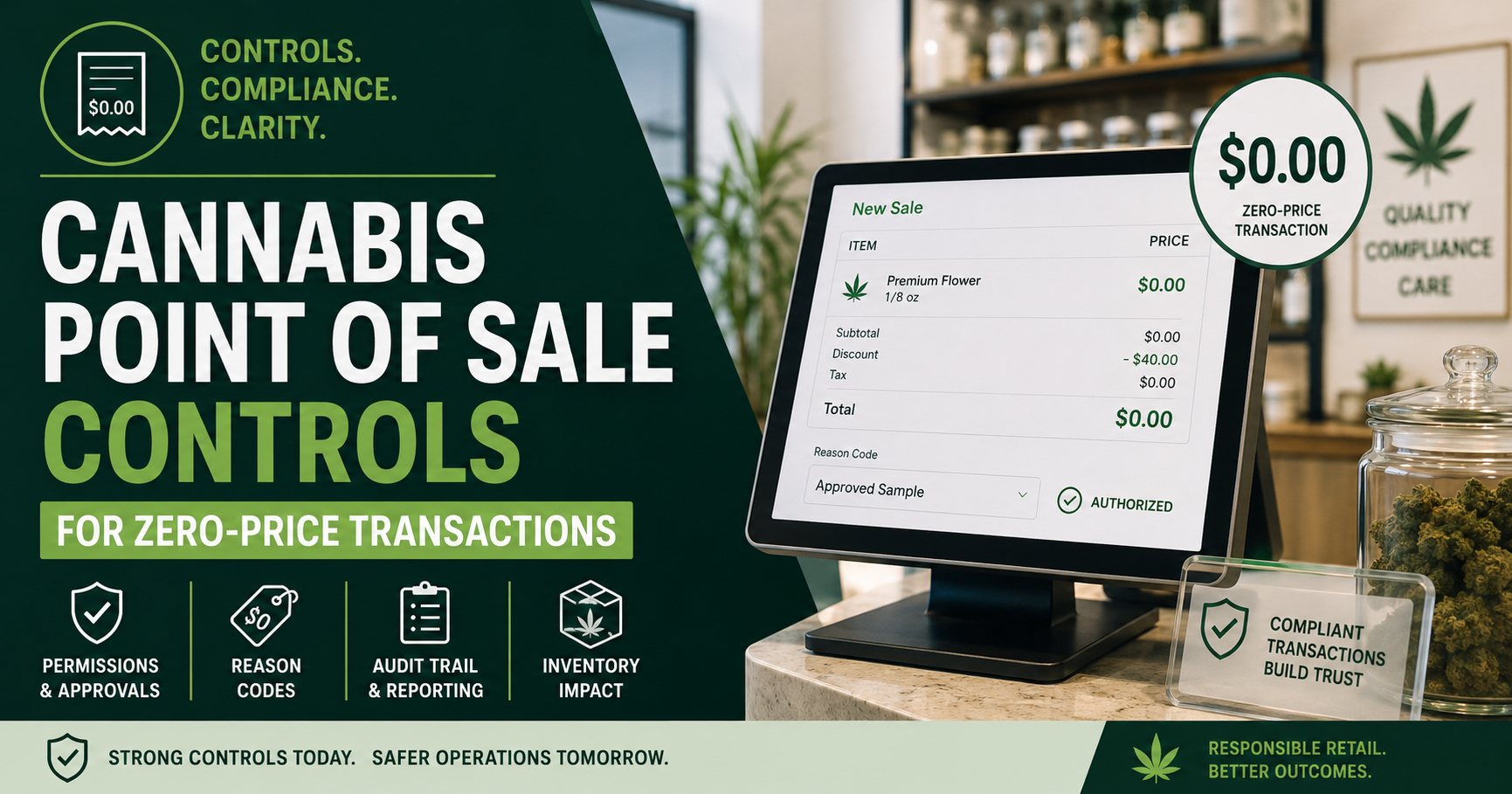
A zero-price transaction can look harmless at checkout: the customer receives a product, the line item shows $0.00, and no payment is collected. In a regulated cannabis store, however, that event can affect inventory, tax logic, promotions, employee accountability, and state reporting. A $0 transaction should never be treated as a normal sale with the price simply erased.
For retailers using an IndicaOnline POS system, zero-price controls should make the business reason visible before the transaction is completed. The safest workflow distinguishes a legitimate non-revenue movement from an accidental discount, unauthorized giveaway, test transaction, or pricing error.
Cannabis rules vary sharply by jurisdiction. Oregon guidance, for example, states that retailers cannot give away marijuana items for free or use nominal-price sales for promotional purposes. That does not create a nationwide rule, but it shows why a dispensary POS should not assume that a $0.00 cannabis line is automatically permitted.
What Counts as a Zero-Price Transaction?
A zero-price event is any completed or attempted transaction in which an item that normally has a retail value reaches a final price of $0.00.
Possible causes include:
- a 100% discount;
- a manager price override;
- an approved sample or non-revenue item;
- customer service compensation;
- a test transaction entered in production;
- an incorrect product price.
The same $0.00 outcome can represent several very different business events. The POS needs enough context to tell them apart.
Separate Zero Price From Training Mode
Training transactions should normally live in a non-production environment. They should not create real sales, inventory deductions, payment activity, or compliance reporting.
If an employee creates a $0 sale in production simply to practice checkout, the business may create an unnecessary live inventory event.
A cannabis POS platform should distinguish:
- training mode;
- test or sandbox activity;
- legitimate live zero-price transactions.
A zero-dollar total does not make a production transaction harmless.
Require a Reason Code
A $0 line item should not be completed without a clear reason.
Useful reason codes might include:
- approved sample;
- authorized customer adjustment;
- damaged item replacement;
- manager-approved exception;
- pricing correction.
Avoid relying on a generic “Other” reason for most activity. Structured reasons make review more useful.
Restrict Who Can Create a Zero-Price Sale
Budtenders should not automatically have permission to reduce any product to zero.
POS software for dispensaries can use role-based controls such as:
- cashier: no zero-price override;
- shift lead: limited approved reasons;
- manager: broader authorization;
- administrator: configuration access.
The ability to remove 100% of a product’s price should be treated as a high-impact permission.
Preserve the Original Price
The transaction record should keep the normal selling price even when the final customer price becomes zero.
For example:
- regular price: $40;
- adjustment: -$40;
- final price: $0;
- reason: approved exception.
If the system stores only $0, managers lose context needed for reporting and investigation.
Check Whether the Product Can Legally Be Free
Cannabis promotional rules are not uniform across the United States. Some jurisdictions restrict free cannabis, nominal-price promotions, samples, giveaways, or combinations of cannabis with other purchases.
The Metrc Oregon sales guidance notes that Oregon retailers cannot give away marijuana items for free and cannot sell marijuana at a nominal price for promotional purposes.
A compliant cannabis retail platform should therefore let operators configure rules by location rather than applying one universal zero-price setting.
Keep Inventory Effects Accurate
A legitimate zero-revenue transaction can still involve real inventory movement.
If a product physically leaves the store through an authorized transaction, the dispensary inventory and POS system should record the correct SKU, regulated package, quantity, and transaction type.
Revenue can be zero while inventory movement is real.
Prevent Zero-Price Sales From Replacing Other Workflows
Employees should not use a $0 sale as an informal substitute for waste, return, destruction, sample, or inventory-adjustment workflows. Those events may have different compliance meanings.
A point-of-sale built for cannabis retail should direct staff to the correct workflow instead of using zero-price checkout as a universal shortcut.
Review Tax Treatment Separately
A $0 transaction does not automatically mean the tax treatment is obvious. Tax rules can depend on the transaction type, discount structure, jurisdiction, and whether value is exchanged elsewhere.
Retailers should have their tax configuration reviewed by qualified professionals rather than asking budtenders to make tax decisions manually.
Price, tax, and compliance status are separate controls.
Block Accidental Zero Prices
Some zero-price events are not intentional. They may appear because:
- a new SKU has no price;
- an import overwrote a price field;
- a promotion was configured at 100%;
- discounts stacked unexpectedly;
- a migration created blank values.
Dispensary management software should flag products with a retail price of zero before they become available to customers.
Monitor Zero-Price Patterns
Individual exceptions may be legitimate. Patterns can reveal larger issues.
Managers can review:
- zero-price transactions by employee;
- products most frequently reduced to zero;
- activity by store or terminal;
- time-of-day patterns;
- reason-code usage;
- manager approvals.
A spike may indicate a broken promotion, unclear policy, misuse of permissions, or training problems.
Exception reporting is most useful when it helps explain behavior, not merely count it.
Keep Receipts and Audit Records Clear
If a legitimate zero-price transaction is completed, the audit trail should preserve:
- original product price;
- final price;
- reason;
- employee;
- approving manager;
- date and time;
- transaction identifier.
This makes the record distinguishable from a deleted item or incomplete sale.
Handle Ecommerce Carefully
Online systems can expose zero-price products if catalog data is published before validation.
A retail POS for cannabis stores should prevent products with invalid price data from becoming purchasable online. If a legitimate zero-price program exists, ecommerce should apply the same eligibility and authorization rules used in-store.
Build a Daily Zero-Price Review
During the Shift
Employees should:
- use approved reason codes;
- avoid unauthorized overrides;
- escalate unexpected $0 products;
- follow the correct inventory workflow.
At Shift Close
Managers can:
- review completed zero-price transactions;
- confirm approvals;
- check package deductions;
- investigate unusual patterns.
Final Takeaway
Zero-price transactions are not simply transactions with no revenue. In cannabis retail, they can touch pricing, inventory, permissions, promotions, taxes, compliance reporting, and audit history.
The strongest POS control requires a valid reason, preserves the original value, restricts authorization, records the inventory effect, and makes every $0 event easy to review. When zero-price activity is treated as a controlled exception instead of a shortcut, dispensaries can reduce pricing errors and keep transaction records more trustworthy.