
NEW YORK DISPENSARY POS: RETAILER SAMPLE TRACKING IN METRC

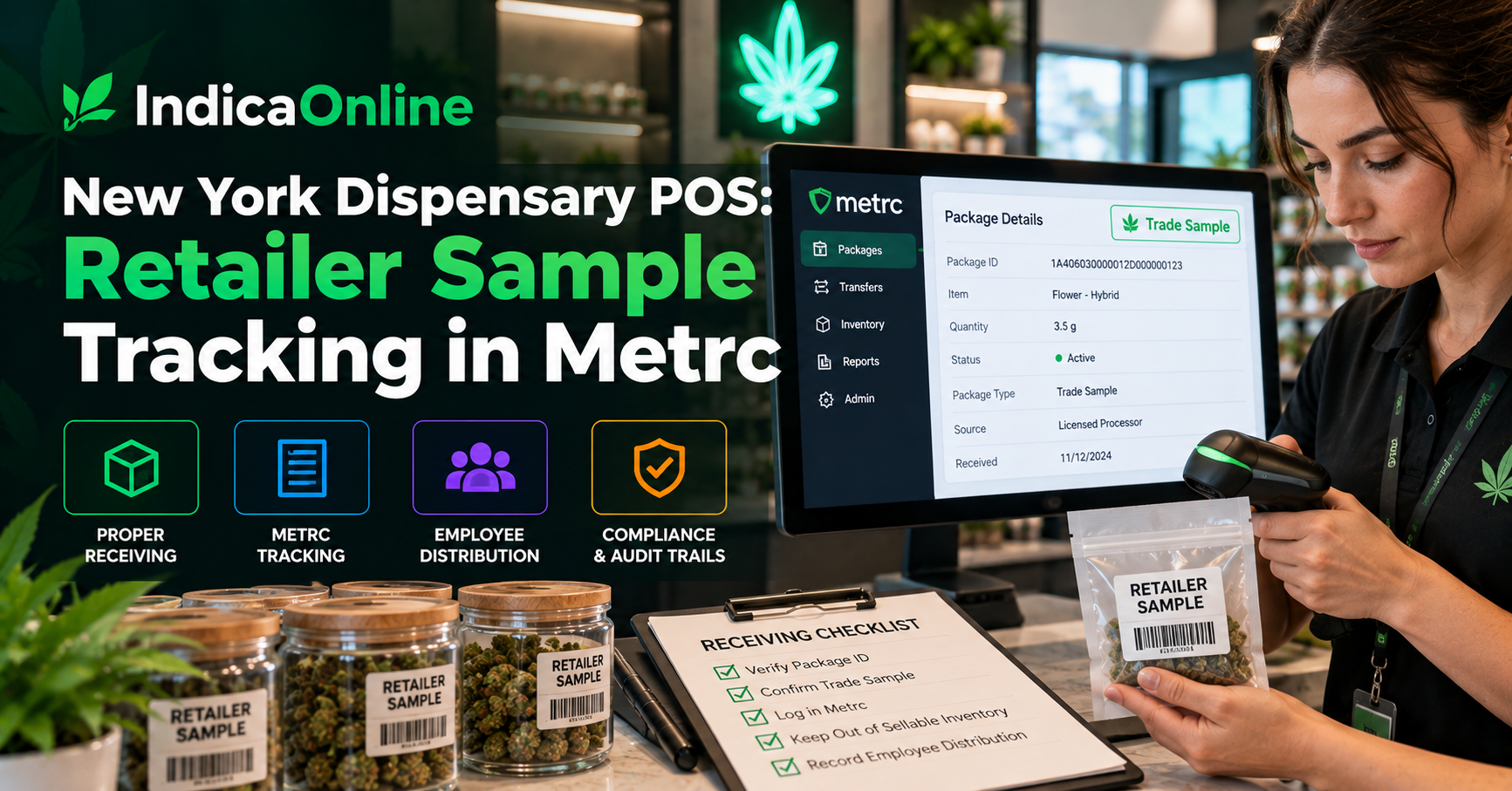
Retailer samples can help New York dispensaries evaluate products before deciding whether to carry them, but samples are still regulated cannabis inventory. They cannot be treated like ordinary promotional merchandise or handed to customers as freebies.
For retailers using New York dispensary POS platform, the goal is to keep sample inventory separate from sellable stock while preserving the link between the physical package, Metrc, receiving records, and employee use. IndicaOnline describes Metrc synchronization, manifest and package imports, live inventory tracking, and audit trails for New York operators.
New York OCM says eligible suppliers may provide free retailer samples to a dispensary that does not already carry the sampled product for the purpose of negotiating a sale. The samples must be entered in the electronic inventory tracking system, labeled as retailer samples, recorded on a transport manifest, and logged by the receiving dispensary before use.
A free sample is still traceable regulated inventory.
Understand What Counts as a Retailer Sample
OCM currently states that cultivators, processors, microbusinesses, distributors, RODs, and RONDs may provide retailer samples to dispensaries that do not already carry the product.
Retailer samples may be used by the dispensary and its employees, but they cannot be:
- sold to consumers;
- given away to consumers;
- used as customer promotions;
- treated as ordinary sellable inventory.
The word “sample” does not create an exception to tracking or giveaway rules. OCM specifically states that retailer samples cannot be sold or given to consumers.
Receive Samples Through the Correct Metrc Workflow
Metrc Bulletin NY_IB_0009 provides New York guidance for the Trade/Vendor Sample process and explains how sample packages should be identified and transferred through Metrc. The bulletin applies to vendor samples transferred without normal monetary value under New York’s sample rules.
When a sample arrives, receiving staff should verify:
- supplier and license information;
- package identifier;
- product and quantity;
- retailer-sample labeling;
- transport manifest;
- Metrc sample designation;
- normal packaging and labeling compliance.
Do not distribute the sample until receiving is complete.
Log the Sample Before Anyone Uses It
OCM requires the receiving dispensary to log the retailer sample into the tracking system before use.
An employee should not take a sample directly from a supplier representative and plan to enter it later.
The correct sequence is receive, verify, record, then distribute.
This is also why a New York cannabis POS should make non-sellable inventory easy to distinguish from inventory available at checkout.
Keep Samples Out of Sellable Inventory
Review whether the POS and ecommerce feeds prevent sample stock from appearing as:
- units for sale;
- online menu inventory;
- pickup or delivery inventory;
- normal replenishment stock.
For a cannabis ecommerce platform New York retailers use, sample inventory should never inflate customer-facing availability.
Retail staff should be able to see that the product physically exists while also understanding that those units are not available for an ordinary consumer transaction.
Use the Metrc Trade Sample Flag Correctly
Metrc instructs licensees to mark the applicable package as a Trade Sample. The flagged package is visually identified within the package workflow.
The bulletin also notes that after a trade-sample package has been transferred to another facility, the trade-sample indicator cannot simply be unflagged.
Verify the package purpose before completing the transfer instead of assuming the designation can be reversed later.
Track Employee Distribution
Once a trade-sample package has been received and units are distributed to appropriate employees, Metrc instructs the licensee to adjust those quantities out of active inventory.
Record Who Received the Sample
Bulletin NY_IB_0009 directs users to select the “Employee Trade Sample” adjustment reason and enter the employee’s first and last name in the required note. If the final quantity is distributed, the package can also be finished.
A manager should capture:
- package ID;
- quantity issued;
- employee name;
- adjustment date;
- remaining quantity;
- finished-package status when applicable.
Employee distribution should leave an audit trail explaining why active inventory decreased.
Do Not Confuse Retailer and Consumer Samples
New York retail rules also allow dispensaries to show secure product samples to consumers for inspection. An authorized employee may allow a customer to see, smell, or inspect the sample, but the customer may not consume, use, or remove it from the dispensary.
Keep internal terminology clear:
- retailer sample — received for the dispensary’s evaluation;
- employee trade sample — quantity distributed to an employee;
- consumer inspection sample — shown to a customer but not consumed or removed.
Clear names reduce the risk of staff applying one sample rule to another situation.
Maintain Packaging and Labeling Controls
OCM states that retailer samples remain subject to normal packaging and labeling requirements. Receiving teams should not accept weak labeling simply because the product has no ordinary wholesale sale price.
Retailers can review the official Metrc New York Trade/Vendor Sample bulletin when creating their receiving and employee-distribution SOP. The bulletin provides the state-specific Metrc steps for flagging sample packages and documenting their removal from active inventory.
Audit Sample Packages Regularly
Sample packages can be overlooked because they do not generate ordinary retail revenue. Include them in inventory audits anyway.
Sample Audit Checklist
Review:
- active trade-sample packages;
- physical and Metrc quantity;
- employees who received samples;
- completed adjustments;
- packages that should be finished;
- sample inventory appearing in sellable channels.
If Metrc shows five sample units but only two remain physically, investigate the difference rather than making an unexplained correction.
A zero-dollar product still needs an explainable inventory history.
Standardize the Workflow Across Locations
For multi location dispensary software New York operators, use one sample policy across the company while keeping each package tied to the licensed store that actually received it.
Standardize receiving instructions, naming conventions, employee-distribution procedures, adjustment reasons, and manager review. A central catalog should not blur location-level sample inventory.
This is especially important when the same supplier sends samples to several stores. Each dispensary should be able to explain which package it received and what happened to the units afterward.
Restrict Sample Adjustments
Not every budtender needs permission to alter package quantities. Limit sample adjustments and package finishing to trained inventory managers or other authorized staff.
IndicaOnline’s Metrc integration supports package and manifest imports, real-time inventory synchronization, and audit trails for adjustments and transfers.
Sensitive sample actions should remain attributable to authorized employees.
Managers should review unusual adjustments rather than allowing sample inventory to become a category where quantity changes receive less scrutiny than normal sellable packages.
Build a Retailer Sample SOP
From Receiving to Closeout
Use a repeatable sequence:
- Verify the manifest and physical package.
- Confirm retailer-sample status in Metrc.
- Log the sample before use.
- Keep it unavailable for customer sale.
- Record employee distribution through the proper adjustment.
- Document the employee recipient.
- Reconcile remaining quantity.
- Finish the package when appropriate.
Metrc’s bulletin specifically requires employee-distributed trade-sample quantities to be adjusted from active inventory and provides an Employee Trade Sample reason for that purpose.
The strongest sample workflow treats every free unit with the same traceability discipline as revenue-generating inventory.
Final Thoughts
New York allows retailer samples as a business-to-business evaluation tool, but they remain regulated cannabis. They must be manifested, labeled, entered into the tracking system, received before use, and kept away from consumer sale or giveaway. OCM currently says there are no numerical retailer-sample limits, while reserving the ability to establish limits later.
A dispensary POS system New York operators use can help separate sample inventory from normal retail stock and preserve package-level visibility. Metrc documents how the sample entered the dispensary and how quantities left active inventory when distributed to employees.
A retailer sample should never become “free inventory” that disappears from the system. Every unit should remain explainable from receipt through employee distribution.