
HOW OREGON CANNABIS POS PREVENTS METRC RECONCILIATION GAPS
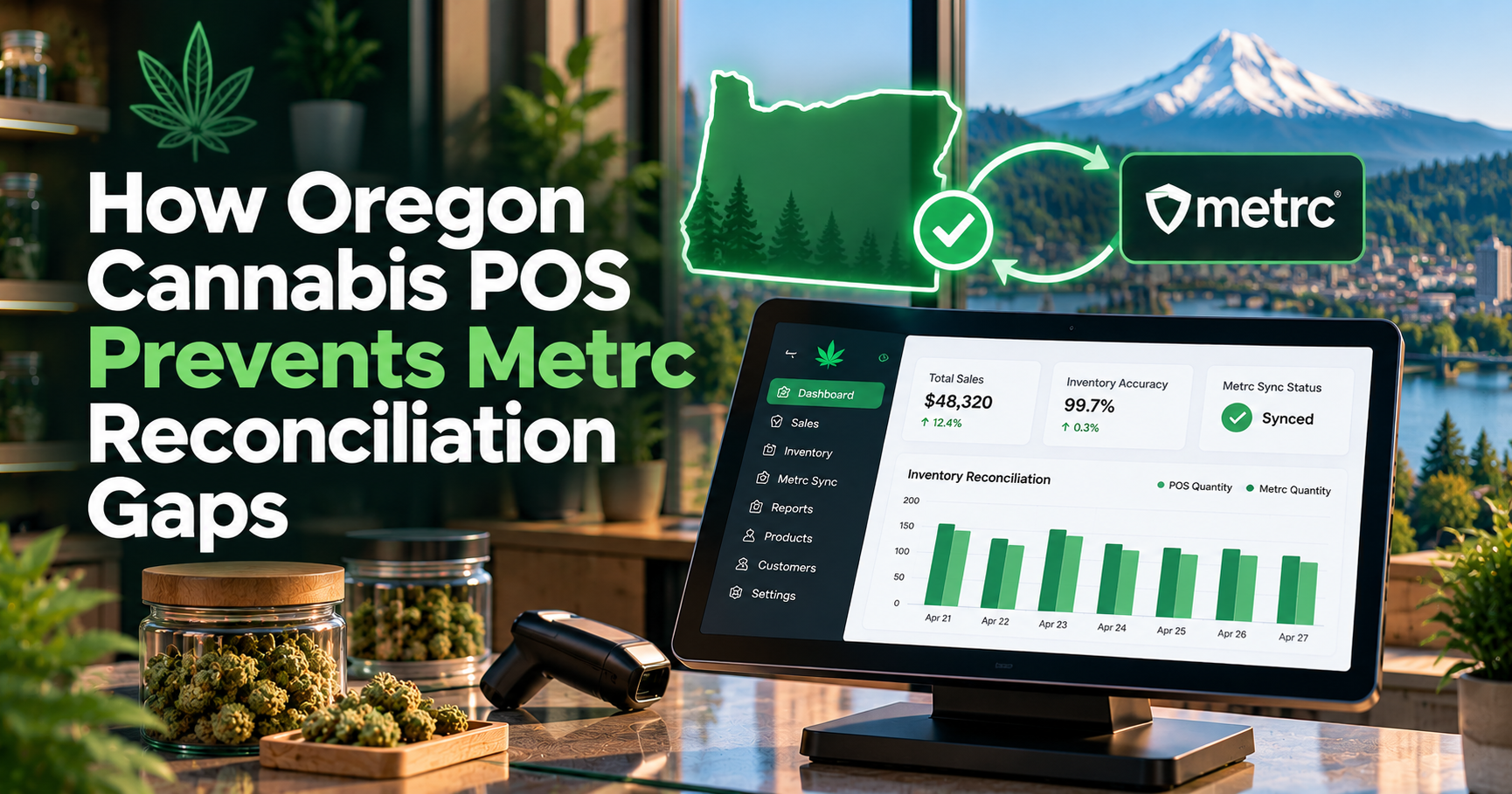
Inventory reconciliation is one of the most important daily How Oregon Cannabis POS Prevents Metrc Reconciliation Gapcontrols for an Oregon cannabis retailer. Every sale, transfer, adjustment, return, and package change can affect the quantity recorded in the store's point-of-sale system and in Oregon's Cannabis Tracking System, which uses Metrc. When those records stop matching, even a small discrepancy can become difficult to investigate after several busy days.
A reliable Metrc-compliant POS for Oregon should help dispensaries keep retail transactions and package-level inventory aligned throughout the day. The objective is not simply to send data to Metrc. The POS should make exceptions visible early enough for staff to understand what happened before an inventory difference grows into a larger reconciliation problem.
Oregon OLCC guidance requires facilities using CTS to perform daily reconciliation and timely reporting so inventory activity remains accurate from day to day. Any change affecting marijuana inventory must be reflected in CTS.
What Is a Metrc Reconciliation Gap?
A reconciliation gap exists when the physical inventory, POS balance, and Metrc record do not agree.
For example, a package may physically contain 36 units while the Oregon cannabis POS shows 35 and Metrc shows 37. The difference could come from a missed sale, a duplicate submission, an incorrect adjustment, or a transaction associated with the wrong package.
Common reconciliation gaps include:
-
sales missing from Metrc;
-
duplicate sales records;
-
incorrect package quantities;
-
transactions assigned to the wrong package;
-
delayed synchronization;
-
unrecorded waste;
-
incorrect returns or voids;
-
transfer discrepancies;
-
physical counts that differ from digital balances.
Reconciliation is not simply about forcing numbers to match. It is about identifying why they stopped matching.
Why Daily Reconciliation Matters in Oregon
OLCC states that marijuana inventory tracked in CTS must be reconciled daily. The agency explains that inventory should be accurate at the beginning of each day, with discrepancies reported and packages adjusted when appropriate.
This makes reconciliation an operational routine rather than an occasional audit exercise.
A retailer that waits several weeks to investigate discrepancies may need to reconstruct hundreds or thousands of transactions. A discrepancy found on the same day is usually much easier to trace.
Daily Checks Reduce Investigation Time
A practical daily review can compare:
-
physical quantity;
-
POS quantity;
-
Metrc package balance;
-
recorded sales;
-
returns and voids;
-
adjustments;
-
transfers;
-
waste events.
If all three inventory views agree, managers can start the next day with greater confidence.
Small discrepancies are usually easier and cheaper to investigate than accumulated discrepancies.
How POS Integration Reduces Manual Entry
Manual re-entry is one of the easiest ways to create differences between systems.
Without integration, an employee may complete a transaction in the POS and later enter related information separately into Metrc. Each additional step creates another opportunity for incorrect quantities, package IDs, or duplicate records.
A cannabis POS for Oregon dispensaries can reduce this risk by transmitting supported retail activity through an API connection.
OLCC notes that licensees may manually enter information into CTS or use their preferred POS, while certified API providers have been confirmed to interface accurately with CTS.
Automation can help reduce:
-
duplicate data entry;
-
transcription errors;
-
missed submissions;
-
package-selection mistakes;
-
delayed reporting.
However, automation does not eliminate the need for verification.
Integration should reduce manual work, not remove management oversight.
Package-Level Tracking Is Essential
Cannabis inventory cannot be managed accurately using product names alone.
A dispensary may carry several packages containing the same strain, brand, size, or product type. Each package can have a different remaining balance and tracking history.
An Oregon dispensary POS platform should therefore connect each transaction to the correct source package.
Useful controls can include:
-
package-specific identifiers;
-
barcode scanning;
-
warnings for inactive packages;
-
real-time package balances;
-
searchable package histories;
-
restrictions on overselling.
If a budtender sells the correct product but selects the wrong package, total store inventory may appear correct while individual package balances become inaccurate.
Monitor Failed Metrc Submissions
One of the most important features in POS software for Oregon cannabis retailers is visibility into synchronization failures.
A transaction can complete successfully at checkout but still fail when the POS attempts to send information to Metrc.
Possible causes include:
-
temporary connectivity problems;
-
invalid package information;
-
insufficient quantity;
-
API interruptions;
-
incorrect units;
-
permissions issues.
The POS should clearly distinguish between successful, pending, and failed submissions.
Failed Transactions Should Be Easy to Find
Managers should not need to search through every completed sale.
A useful exception dashboard may show:
-
transaction number;
-
timestamp;
-
package ID;
-
employee;
-
error status;
-
retry status;
-
error message.
A visible failed submission is manageable. A silent failure can become an inventory problem.
Do Not Automatically Resubmit Every Error
A failed confirmation does not always mean the original transaction failed.
Sometimes the POS may send information successfully but fail to receive the expected response. Automatically resubmitting the same record without checking can create duplicate data.
A safer workflow is to:
-
identify the questionable transaction;
-
check its status;
-
verify whether it already appears in Metrc;
-
review the affected package balance;
-
correct incorrect data if necessary;
-
retry only when appropriate.
This is especially important for a metrc integration Oregon workflow where many daily transactions are transmitted automatically.
Reconcile Physical Inventory With Digital Records
POS-to-Metrc synchronization is only part of reconciliation.
Managers also need to confirm that digital quantities match the actual products inside the dispensary.
OLCC describes CTS as the system used to track marijuana inventory and requires changes affecting inventory to be reflected in the system.
Regular physical checks can identify problems that software alone cannot detect, such as:
-
misplaced products;
-
handling loss;
-
damaged inventory;
-
unrecorded waste;
-
receiving mistakes;
-
incorrect package selection.
A compliant cannabis POS in Oregon should make physical count results easy to compare with expected package balances.
Investigate Before Adjusting Inventory
When physical inventory and Metrc disagree, the fastest-looking solution may be to change the quantity until everything matches.
That approach can hide the original problem.
Before making an adjustment, review:
-
recent sales;
-
package history;
-
returns;
-
voids;
-
transfers;
-
waste;
-
employee activity.
OLCC specifically notes that discrepancies must be reported and packages adjusted to reflect correct inventory when appropriate. For example, waste created during processing or repackaging must be reflected correctly in CTS.
An adjustment should describe a real inventory event, not act as a shortcut around investigation.
Receiving Errors Can Create Reconciliation Gaps
Some discrepancies begin before a product ever reaches the sales floor.
When receiving inventory, staff should verify:
-
package identifiers;
-
product name;
-
quantity;
-
unit of measure;
-
manifest information;
-
physical products received.
An incorrect quantity accepted during receiving can remain hidden until a later inventory count.
This is why Oregon seed-to-sale dispensary software should make receiving a controlled workflow rather than a simple inventory import.
Returns and Voids Need Special Attention
Returns and voids can also create mismatches if one system updates while another does not.
Managers should understand:
-
how a void changes inventory;
-
whether the original transaction is reversed;
-
what happens to the package balance;
-
how the event appears in Metrc;
-
whether manager approval is required.
A point-of-sale for Oregon dispensaries should preserve the full transaction history instead of simply deleting the original sale.
Auditability is more valuable than making an incorrect transaction disappear.
Ecommerce Can Create Another Inventory Layer
A cannabis ecommerce platform Oregon retailer uses may display inventory based on POS quantities.
If POS and Metrc balances diverge, online availability can also become inaccurate.
For example, the website might show five units available while the actual sellable quantity is only three.
Retailers should verify whether ecommerce inventory updates:
-
in real time;
-
on a fixed schedule;
-
after every completed sale;
-
after inventory adjustments;
-
after failed integrations recover.
The more systems that rely on the POS as their inventory source, the more important reconciliation becomes.
Multi-Location Operators Need Location-Level Controls
Multi location dispensary software Oregon businesses use should keep each licensed location's inventory clearly separated.
Managers may want a consolidated company dashboard, but reconciliation should still be possible at the individual store and package level.
Useful reporting includes:
-
unresolved differences by location;
-
failed syncs by store;
-
unusual adjustments;
-
inventory variance;
-
package activity;
-
reconciliation status.
A company-wide total can hide a problem at one location.
Compliance data should remain traceable to the licensed facility where the inventory actually exists.
Create a Daily Reconciliation Workflow
Technology works best when supported by a repeatable store procedure.
A practical daily workflow might include:
Before Closing
Review:
-
pending transactions;
-
failed Metrc submissions;
-
unusual voids;
-
returns;
-
significant adjustments.
After Sales Activity Ends
Compare:
-
physical high-risk inventory;
-
POS balances;
-
Metrc balances.
Before the Next Business Day
Resolve unexplained discrepancies and confirm that required inventory changes have been reflected appropriately.
OLCC's official Tracking in CTS guidance explains that ongoing tracking requires daily reconciliation and timely reporting to keep inventory activity accurate.
Questions to Ask a POS Vendor
When evaluating dispensary software in Oregon, ask vendors to demonstrate reconciliation rather than only a successful checkout.
Useful questions include:
-
Can I view package-level balances?
-
How are failed Metrc submissions displayed?
-
Can pending transactions be filtered?
-
What happens during a Metrc outage?
-
How are duplicate submissions prevented?
-
Can I review package transaction history?
-
How are voids and returns synchronized?
-
Can I compare physical counts with expected balances?
-
How are inventory adjustments documented?
-
Can managers review unresolved exceptions by location?
A strong demo should show what happens when something goes wrong, not only when every transaction succeeds.
Final Takeaway
Metrc reconciliation gaps are easier to prevent when Oregon dispensaries combine reliable POS integration with disciplined daily review.
The POS should connect transactions to the correct packages, expose failed submissions, preserve transaction history, and make differences easy to investigate. Physical inventory checks remain important because synchronization alone cannot detect every operational mistake.
For Oregon retailers, reconciliation should answer three questions every day: does the product physically exist, does the POS show the correct amount, and does CTS reflect the same inventory activity?
The strongest compliance workflow does not wait for a major discrepancy. It continuously identifies small exceptions while they are still easy to explain.
With accurate package tracking, visible synchronization status, controlled corrections, and a consistent daily reconciliation process, an Oregon cannabis POS can help dispensaries reduce inventory gaps and maintain much more reliable operational records.