
PROFESSIONAL-CLOUD-ARCHITECT최신핫덤프 & PROFESSIONAL-CLOUD-ARCHITECT
BONUS!!! ITDumpsKR Professional-Cloud-Architect 시험 문제집 전체 버전을 무료로 다운로드하세요: https://drive.google.com/open?id=1husui2F6ExtW9yYQffDCYw6bLqpUMytX
아직도 Google인증Professional-Cloud-Architect시험준비를 어떻게 해야 할지 망설이고 계시나요? 고객님의 IT인증시험준비길에는 언제나 ITDumpsKR가 곁을 지켜주고 있습니다. ITDumpsKR시험공부자료를 선택하시면 자격증취득의 소원이 이루어집니다. Google인증Professional-Cloud-Architect시험덤프는ITDumpsKR가 최고의 선택입니다.
Google Professional-Cloud-Architect Exam Syllabus Topics:
| Section | Objectives |
|---|---|
| Analyzing and optimizing technical and business processes | - Analyzing and defining business processes
|
| Managing implementation | - Advising development/operation team(s) to ensure successful deployment
|
| Designing and planning a cloud solution architecture | - Designing network, storage, and compute resources
|
| Ensuring solution and operations reliability | - Deployment and release management
- Assisting with support
|
| Managing and provisioning a solution infrastructure | - Configuring network topologies
|
| Designing for security and compliance | - Designing for compliance
|
>> Professional-Cloud-Architect최신핫덤프 <<
Professional-Cloud-Architect응시자료, Professional-Cloud-Architect Dumps
Google인증 Professional-Cloud-Architect시험은 빨리 패스해야 되는데 어디서부터 어떻게 시험준비를 시작해야 하는지 갈피를 잡을수 없는 분들은ITDumpsKR가 도와드립니다. ITDumpsKR의 Google인증 Professional-Cloud-Architect덤프만 공부하면 시험패스에 자신이 생겨 불안한 상태에서 벗어날수 있습니다.덤프는 시장에서 가장 최신버전이기에 최신 시험문제의 모든 시험범위와 시험유형을 커버하여Google인증 Professional-Cloud-Architect시험을 쉽게 패스하여 자격증을 취득하여 찬란한 미래에 더 가깝도록 도와드립니다.
최신 Google Cloud Certified Professional-Cloud-Architect 무료샘플문제 (Q348-Q353):
질문 # 348
One of your primary business objectives is being able to trust the data stored in your application.
You want to log all changes to the application data. How can you design your logging system to verify authenticity of your logs?
- A. Write the log concurrently in the cloud and on premises.
- B. Create a JSON dump of each log entry and store it in Google Cloud Storage.
- C. Use a SQL database and limit who can modify the log table.
- D. Digitally sign each timestamp and log entry and store the signature.
정답:B
설명:
Write a log entry. If the log does not exist, it is created. You can specify a severity for the log entry, and you can write a structured log entry by specifying --payload-type=json and writing your message as a JSON string:
gcloud logging write LOG STRING
gcloud logging write LOG JSON-STRING --payload-type=json
References: https://cloud.google.com/logging/docs/reference/tools/gcloud-logging
질문 # 349
Your marketing department wants to send out a promotional email campaign. The development team wants to minimize direct operation management. They project a wide range of possible customer responses, from 100 to 500,000 click-throughs per day. The link leads to a simple website that explains the promotion and collects user information and preferences. Which infrastructure should you recommend?
- A. Use a Google Container Engine cluster to serve the website and store data to persistent disk.
- B. Use a single compute Engine virtual machine (VM) to host a web server, backed by Google Cloud SQL.
- C. Use Google App Engine to serve the website and Google Cloud Datastore to store user data.
- D. Use a managed instance group to serve the website and Google Cloud Bigtable to store user data.
정답:C
질문 # 350
Your company's test suite is a custom C++ application that runs tests throughout each day on Linux virtual machines. The full test suite takes several hours to complete, running on a limited number of on premises servers reserved for testing. Your company wants to move the testing infrastructure to the cloud, to reduce the amount of time it takes to fully test a change to the system, while changing the tests as little as possible. Which cloud infrastructure should you recommend?
- A. Google Cloud Dataproc to run Apache Hadoop jobs to process each test
- B. Google App Engine with Google Stackdriver for logging
- C. Google Compute Engine unmanaged instance groups and Network Load Balancer
- D. Google Compute Engine managed instance groups with auto-scaling
정답:D
설명:
Google Compute Engine enables users to launch virtual machines (VMs) on demand. VMs can be launched from the standard images or custom images created by users.
Managed instance groups offer autoscaling capabilities that allow you to automatically add or remove instances from a managed instance group based on increases or decreases in load.
Autoscaling helps your applications gracefully handle increases in traffic and reduces cost when the need for resources is lower.
Incorrect Answers:
B: There is no mention of incoming IP data traffic for the custom C++ applications.
C: Apache Hadoop is not fit for testing C++ applications. Apache Hadoop is an open-source software framework used for distributed storage and processing of datasets of big data using the MapReduce programming model.
D: Google App Engine is intended to be used for web applications.
Google App Engine (often referred to as GAE or simply App Engine) is a web framework and cloud computing platform for developing and hosting web applications in Google-managed data centers.
References: https://cloud.google.com/compute/docs/autoscaler/
질문 # 351
Your customer is moving an existing corporate application to Google Cloud Platform from an on- premises data center. The business owners require minimal user disruption. There are strict security team requirements for storing passwords. What authentication strategy should they use?
- A. Ask users to set their Google password to match their corporate password.
- B. Use G Suite Password Sync to replicate passwords into Google.
- C. Federate authentication via SAML 2.0 to the existing Identity Provider.
- D. Provision users in Google using the Google Cloud Directory Sync tool.
정답:C
설명:
By using Google Cloud Directory Sync, you've already automated the creation and maintenance of users and tied their lifecycle to the users in Active Directory.
Although Google Cloud Directory Sync provisions user account details, it doesn't synchronize passwords. Whenever a user needs to authenticate in Google Cloud, the authentication must be delegated back to Active Directory, which is done by using AD FS and the Security Assertion Markup Language (SAML) protocol. This setup ensures that only Active Directory has access to user credentials and is enforcing any existing policies or multi-factor authentication (MFA) mechanisms. Moreover, it establishes a single sign-on experience between your on-premises environment and Google.
https://cloud.google.com/architecture/identity/federating-gcp-with-active-directory-configuring- single-sign-on
질문 # 352
For this question refer to the TerramEarth case study.
Which of TerramEarth's legacy enterprise processes will experience significant change as a result of increased Google Cloud Platform adoption.
- A. Capacity planning, utilization measurement, data center expansion
- B. Capacity planning, TCO calculations, opex/capex allocation
- C. Opex/capex allocation, LAN changes, capacity planning
- D. Data Center expansion, TCO calculations, utilization measurement
정답:B
설명:
Topic 1, TerramEarth Case Study
Company Overview
TerramEarth manufactures heavy equipment for the mining and agricultural industries: About 80% of their business is from mining and 20% from agriculture. They currently have over 500 dealers and service centers in
100 countries. Their mission is to build products that make their customers more productive.
Company Background
TerramEarth formed in 1946, when several small, family owned companies combined to retool after World War II. The company cares about their employees and customers and considers them to be extended members of their family.
TerramEarth is proud of their ability to innovate on their core products and find new markets as their customers' needs change. For the past 20 years trends in the industry have been largely toward increasing productivity by using larger vehicles with a human operator.
Solution Concept
There are 20 million TerramEarth vehicles in operation that collect 120 fields of data per second. Data is stored locally on the vehicle and can be accessed for analysis when a vehicle is serviced. The data is downloaded via a maintenance port. This same port can be used to adjust operational parameters, allowing the vehicles to be upgraded in the field with new computing modules.
Approximately 200,000 vehicles are connected to a cellular network, allowing TerramEarth to collect data directly. At a rate of 120 fields of data per second, with 22 hours of operation per day. TerramEarth collects a total of about 9 TB/day from these connected vehicles.
Existing Technical Environment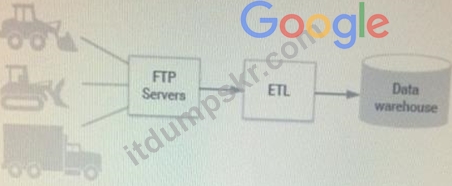
TerramEarth's existing architecture is composed of Linux-based systems that reside in a data center. These systems gzip CSV files from the field and upload via FTP, transform and aggregate them, and place the data in their data warehouse. Because this process takes time, aggregated reports are based on data that is 3 weeks old.
With this data, TerramEarth has been able to preemptively stock replacement parts and reduce unplanned downtime of their vehicles by 60%. However, because the data is stale, some customers are without their vehicles for up to 4 weeks while they wait for replacement parts.
Business Requirements
* Decrease unplanned vehicle downtime to less than 1 week, without increasing the cost of carrying surplus inventory
* Support the dealer network with more data on how their customers use their equipment IP better position new products and services.
* Have the ability to partner with different companies-especially with seed and fertilizer suppliers in the fast-growing agricultural business-to create compelling joint offerings for their customers CEO Statement We have been successful in capitalizing on the trend toward larger vehicles to increase the productivity of our customers. Technological change is occurring rapidly and TerramEarth has taken advantage of connected devices technology to provide our customers with better services, such as our intelligent farming equipment.
With this technology, we have been able to increase farmers' yields by 25%, by using past trends to adjust how our vehicles operate. These advances have led to the rapid growth of our agricultural product line, which we expect will generate 50% of our revenues by 2020.
CTO Statement
Our competitive advantage has always been in the manufacturing process with our ability to build better vehicles for tower cost than our competitors. However, new products with different approaches are constantly being developed, and I'm concerned that we lack the skills to undergo the next wave of transformations in our industry. Unfortunately, our CEO doesn't take technology obsolescence seriously and he considers the many new companies in our industry to be niche players. My goals are to build our skills while addressing immediate market needs through incremental innovations.
질문 # 353
......
Google Professional-Cloud-Architect인증시험은 전문적인 관련지식을 테스트하는 인증시험입니다. ITDumpsKR는 여러분이Google Professional-Cloud-Architect인증시험을 통과할 수 잇도록 도와주는 사이트입니다. 여러분은 응시 전 저희의 문제와 답만 잘 장악한다면 빠른 시일 내에 많은 성과 가 있을 것입니다.
Professional-Cloud-Architect응시자료: https://www.itdumpskr.com/Professional-Cloud-Architect-exam.html
- Professional-Cloud-Architect높은 통과율 덤프샘플문제 ???? Professional-Cloud-Architect적중율 높은 인증덤프 ???? Professional-Cloud-Architect최고품질 덤프자료 ???? 검색만 하면▛ www.koreadumps.com ▟에서➤ Professional-Cloud-Architect ⮘무료 다운로드Professional-Cloud-Architect인기공부자료
- Professional-Cloud-Architect최신핫덤프 최신 인증시험 대비자료 ???? 검색만 하면⮆ www.itdumpskr.com ⮄에서( Professional-Cloud-Architect )무료 다운로드Professional-Cloud-Architect시험대비 인증덤프
- Professional-Cloud-Architect덤프문제집 ☘ Professional-Cloud-Architect최신 업데이트 시험공부자료 ???? Professional-Cloud-Architect높은 통과율 덤프샘플문제 ???? ⏩ www.pass4test.net ⏪을 통해 쉽게➥ Professional-Cloud-Architect ????무료 다운로드 받기Professional-Cloud-Architect완벽한 덤프
- Professional-Cloud-Architect최신핫덤프 최신 인증시험 대비자료 ???? 지금“ www.itdumpskr.com ”에서➡ Professional-Cloud-Architect ️⬅️를 검색하고 무료로 다운로드하세요Professional-Cloud-Architect퍼펙트 최신 덤프자료
- Professional-Cloud-Architect최신핫덤프 100%시험패스 가능한 덤프 ???? ⮆ www.koreadumps.com ⮄에서✔ Professional-Cloud-Architect ️✔️를 검색하고 무료로 다운로드하세요Professional-Cloud-Architect시험대비 덤프 최신 샘플문제
- Professional-Cloud-Architect최신핫덤프 시험준비에 가장 좋은 기출문제 모은 덤프자료 ???? 「 www.itdumpskr.com 」을 통해 쉽게⇛ Professional-Cloud-Architect ⇚무료 다운로드 받기Professional-Cloud-Architect공부자료
- Professional-Cloud-Architect최신 시험 최신 덤프자료 ???? Professional-Cloud-Architect완벽한 덤프 ???? Professional-Cloud-Architect덤프문제집 ???? ⮆ Professional-Cloud-Architect ⮄를 무료로 다운로드하려면《 www.pass4test.net 》웹사이트를 입력하세요Professional-Cloud-Architect유효한 덤프자료
- Professional-Cloud-Architect 100%시험패스 공부자료 ???? Professional-Cloud-Architect최신 시험 최신 덤프자료 ???? Professional-Cloud-Architect시험대비 인증덤프 ???? “ www.itdumpskr.com ”에서 검색만 하면⇛ Professional-Cloud-Architect ⇚를 무료로 다운로드할 수 있습니다Professional-Cloud-Architect 100%시험패스 공부자료
- Professional-Cloud-Architect최고품질 덤프자료 ???? Professional-Cloud-Architect덤프문제집 ???? Professional-Cloud-Architect완벽한 덤프 ???? 시험 자료를 무료로 다운로드하려면✔ kr.fast2test.com ️✔️을 통해[ Professional-Cloud-Architect ]를 검색하십시오Professional-Cloud-Architect유효한 덤프자료
- Professional-Cloud-Architect최고품질 덤프자료 ???? Professional-Cloud-Architect최신 덤프샘플문제 ???? Professional-Cloud-Architect덤프문제집 ???? 무료로 쉽게 다운로드하려면{ www.itdumpskr.com }에서➤ Professional-Cloud-Architect ⮘를 검색하세요Professional-Cloud-Architect인증덤프공부
- 퍼펙트한 Professional-Cloud-Architect최신핫덤프 최신버전 덤프샘플문제 다운로드 ???? ( www.dumptop.com )을 통해 쉽게《 Professional-Cloud-Architect 》무료 다운로드 받기Professional-Cloud-Architect인증덤프공부
- www.stes.tyc.edu.tw, www.stes.tyc.edu.tw, www.stes.tyc.edu.tw, www.stes.tyc.edu.tw, www.stes.tyc.edu.tw, www.stes.tyc.edu.tw, www.stes.tyc.edu.tw, www.stes.tyc.edu.tw, www.stes.tyc.edu.tw, www.stes.tyc.edu.tw, Disposable vapes
BONUS!!! ITDumpsKR Professional-Cloud-Architect 시험 문제집 전체 버전을 무료로 다운로드하세요: https://drive.google.com/open?id=1husui2F6ExtW9yYQffDCYw6bLqpUMytX