
HP HPE7-S02 FLEXIBLE TESTING ENGINE & INTERACTIVE HPE7-S02 QUEST
Our HPE7-S02 exam questions are authoritatively certified. Our goal is to help you successfully pass relevant HPE7-S02 exam in an efficient learning style. Due to the quality and reasonable prices of our HPE7-S02 training materials, our competitiveness has always been a leader in the world. Our HPE7-S02 Learning Materials have a higher pass rate than other training materials, so we are confident to allow you to gain full results. With our HPE7-S02 exam questions, your success is guaranteed.
HP HPE7-S02 Exam Syllabus Topics:
| Section | Objectives |
|---|---|
| Topic 1: Kubernetes and MLOps Platforms | - Kubernetes Infrastructure
|
| Topic 2: Design and Implement HPE Private Cloud AI Solutions | - AI Infrastructure Integration
|
| Topic 3: Operations, Security, and Troubleshooting | - Monitoring and Management
|
| Topic 4: HPC and High-Performance Infrastructure | - HPC Networking
|
| Topic 5: Compute and Virtualization Solutions | - HPE Compute Platforms
|
>> HP HPE7-S02 Flexible Testing Engine <<
Interactive HPE7-S02 Questions, Online HPE7-S02 Training Materials
The price for HPE7-S02 exam torrent is quite reasonable, you can afford it no matter you are a student or you are an employee in the company. You just need to spend some money, and you can get a certificate. In addition, HPE7-S02 exam dumps are high-quality and accuracy, and you can pass the exam successfully by using them. We also pass guarantee and money back guarantee for your failure of the exam after using HPE7-S02 Exam Dumps. We offer you free update for 365 days after purchasing, and the update version will be sent to your email address automatically.
HP Advanced HPE Compute Integrator Solutions Written Exam Sample Questions (Q48-Q53):
NEW QUESTION # 48
An HPE Private Cloud AI customer wants to prevent Airflow from consuming too many resources on the cluster.
What is one approach you can take to fulfill this request?
- A. From the Airflow UI, reduce the number of slots assigned to the default pool.
- B. Configure the Airflow framework values to adjust the resources assigned to the executor pods.
- C. From the Airflow UI, reduce the memory and CPU for executor pods.
- D. Configure the Airflow framework to enable autoscaling.
Answer: A
Explanation:
D is correct. Airflow pools provide a direct mechanism for controlling task concurrency. Each pool has a defined number of slots, and tasks assigned to that pool consume slots while they execute. Reducing the number of slots in the default pool therefore limits the number of tasks that can run simultaneously and places an upper bound on how aggressively Airflow can consume cluster resources across concurrent DAG activity.
Option A is not the supported control in this scenario; the Airflow UI does not serve as the general editor for executor-pod CPU and memory sizing. Option B is the opposite of the stated objective because enabling autoscaling can increase executor capacity in response to demand. Option C suggests changing framework values for executor resources, but HPE's Airflow integration historically constrains those settings and the exam-tested method for limiting aggregate workload pressure is pool concurrency.
This is a scheduling-level safeguard rather than a Kubernetes quota. In a production environment, pool slots can be combined with platform quotas and workload resource requests to create layered control over resource consumption.
References/topics: Advanced HPE Compute Solutions, Rev. 26.21, Module 4 "Airflow" and Module 7 resource troubleshooting; HPE AI Essentials Airflow documentation, pool slots and maximum simultaneous jobs.
NEW QUESTION # 49
You are planning to demonstrate how you can use KServe to run NIMs on HPE Private Cloud AI.
You have downloaded the CodeLlama-70B-Instruct model to a volume in your namespace named demo-model. The objects that you are planning to deploy are shown below: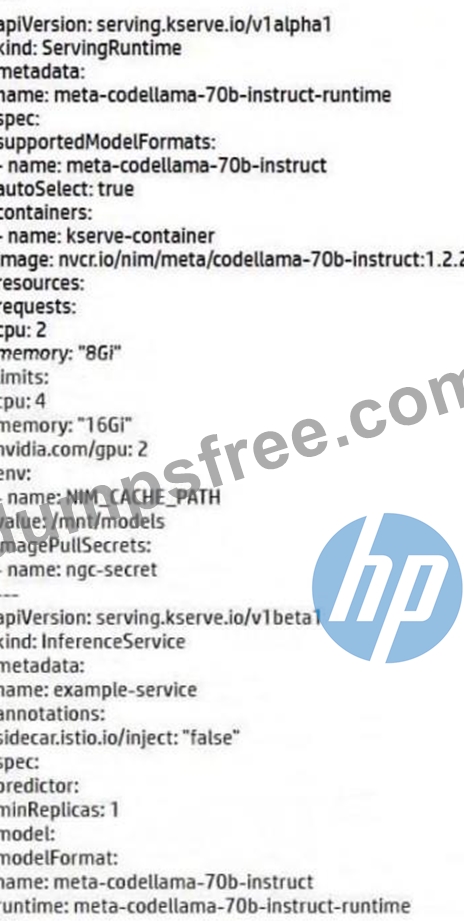
What change should you make to the objects?
- A. In the inferenceservice, change the spec.predictor.model.modelFormat.Name to: pvc://demo- model/codellama-70b-instruct
- B. In the servingruntime, change the NIMCACHEPATH environment variable value to "/mnt/demo- model"
- C. Add this line to the inferenceservice under spec.predictor: storageUri: pvc://demo-model
- D. Add this line to the servingruntime under spec: storageUri: pvc://demo-model
Answer: C
Explanation:
The model is already downloaded to a PVC, so the InferenceService must reference that PVC with storageUri. KServe then mounts the model storage for the predictor; you do not change the model format or ServingRuntime. More precisely, this belongs under the predictor's model spec as storageUri.
NEW QUESTION # 50
An HPE Private Cloud AI customer wants to eliminate the certificate errors that show when users access HPE AI Essentials. The customer has created a certificate signed by their CA to replace the current certificate. The customer has given you the certificate file, private key file, and CA certificate file.
How should you install this certificate?
- A. Use the HPE Private Cloud AI interface to access the VM that hosts the HPE AI Essentials UI. Install the certificate, private key, and CA certificate on that VM.
- B. Delete the current "ingress-cert" certificate and secret in the HPE AI Essentials istio-system namespace.Add a new "ingress-cert" secret in this namespace referencing the provided files.
- C. Log into the Keycloak interface using the credentials stored in the HPE AI Essentials ezaddon-system namespace. Upload the certificate, private key, and CA certificate files in the "ua" realm.
- D. Create a CertificateIssuer that references the CA certificate in the HPE AI Essential cert-manager namespace. Then create an ingress-cert certificate based on the provided certificate and private key in the istio-system namespace.
Answer: B
Explanation:
D is correct for a customer-supplied, already-issued certificate. HPE AI Essentials presents its external TLS identity through the Istio ingress gateway, and the relevant certificate material is held in the ingress-cert secret in the istio-system namespace. When performing the manual replacement workflow, the administrator replaces the existing ingress certificate secret with one populated from the supplied certificate, private key, and CA chain according to HPE's documented format.
Option A is incorrect because the certificate is not installed on a single UI virtual machine; HPE AI Essentials is a Kubernetes-based platform and ingress TLS is handled at the cluster ingress layer. Option B confuses certificate issuance with certificate installation. A ClusterIssuer is appropriate when cert-manager should request and renew a certificate, but the customer has already supplied the signed certificate and key. Option C incorrectly places TLS management in Keycloak.
Rev. 26.21 updated the certificate procedures for HPE AI Essentials 1.9 and later, so administrators should follow the version-specific HPE commands and secret format rather than an older generic Kubernetes recipe.
References/topics: Advanced HPE Compute Solutions, Rev. 26.21, Module 3 "Replacing the Istio ingress gateway certificate"; HPE AI Essentials documentation, manual certificate replacement and ingress-cert access.
NEW QUESTION # 51
A customer's security policy mandates that only digitally signed and verified firmware can run at every boot stage, forming a "chain of trust." Which combination of HPE Gen11 features together deliver this?
- A. HPE OneView + Server Profile Templates
- B. iLO Federation + Active Health System
- C. Smart Storage Administrator + RAID 6
- D. Silicon Root of Trust + UEFI Secure Boot + Trusted Platform Module (TPM)
Answer: D
Explanation:
A verified chain of trust is built from Silicon Root of Trust (hardware-anchored firmware validation), UEFI Secure Boot (validates OS bootloader/kernel signatures), and TPM (secures cryptographic keys and measurements). Federation and Active Health System support fleet management and telemetry, not the trust chain; Smart Storage Administrator/RAID address storage configuration; OneView/Profiles address lifecycle configuration.
NEW QUESTION # 52
What is one benefit of HPE Slingshot for HPC workloads?
- A. It uses bandwidth efficiently with packet-by-packet adaptive routing for MPI and Lustre.
- B. It provides the end-to-end non-blocking architecture required for typical HPC applications.
- C. It provides advanced congestion management based on DiffServ.
- D. It uses InfiniBand NDR to reduce the average end-to-end latency for MPI communications.
Answer: A
Explanation:
HPE Slingshot improves bandwidth utilization with fine-grained adaptive routing; routing decisions can be packet-by-packet for unordered traffic.
NEW QUESTION # 53
......
Our evaluation system for HPE7-S02 test material is smart and very powerful. First of all, our researchers have made great efforts to ensure that the data scoring system of our HPE7-S02 test questions can stand the test of practicality. Once you have completed your study tasks and submitted your training results, the evaluation system will begin to quickly and accurately perform statistical assessments of your marks on the HPE7-S02 exam torrent. In a matter of seconds, you will receive an assessment report based on each question you have practiced on our HPE7-S02 test material. The final result will show you the correct and wrong answers so that you can understand your learning ability so that you can arrange the learning tasks properly and focus on the targeted learning tasks with HPE7-S02 test questions. So you can understand the wrong places and deepen the impression of them to avoid making the same mistake again.
Interactive HPE7-S02 Questions: https://www.dumpsfree.com/HPE7-S02-valid-exam.html
- HPE7-S02 Exam Questions Fee ???? HPE7-S02 Certification Exam Infor ???? HPE7-S02 Latest Exam Camp ???? Search for ➠ HPE7-S02 ???? on ✔ www.vce4dumps.com ️✔️ immediately to obtain a free download ????HPE7-S02 Reliable Test Cost
- HPE7-S02 Certification Exam Infor ???? New HPE7-S02 Braindumps Questions ???? HPE7-S02 Reliable Test Cost ♿ Search for ➡ HPE7-S02 ️⬅️ and easily obtain a free download on { www.pdfvce.com } ↩Popular HPE7-S02 Exams
- Dump HPE7-S02 Collection ???? Instant HPE7-S02 Discount ???? Dump HPE7-S02 Collection ???? Search for { HPE7-S02 } and download exam materials for free through ⇛ www.torrentvce.com ⇚ ????Exam HPE7-S02 Collection Pdf
- Reliable HPE7-S02 Exam Simulator ???? Instant HPE7-S02 Discount ???? HPE7-S02 Reliable Test Braindumps ???? Easily obtain free download of ➥ HPE7-S02 ???? by searching on ✔ www.pdfvce.com ️✔️ ????Reliable HPE7-S02 Test Forum
- Reliable HPE7-S02 Exam Simulator ???? HPE7-S02 Reliable Test Cost ???? HPE7-S02 Certification Exam Infor ???? Copy URL ▶ www.exam4labs.com ◀ open and search for { HPE7-S02 } to download for free ????Instant HPE7-S02 Discount
- Excellent HPE7-S02 Flexible Testing Engine - Trustable Source of HPE7-S02 Exam ???? Simply search for ➥ HPE7-S02 ???? for free download on ➥ www.pdfvce.com ???? ????Exam HPE7-S02 Collection Pdf
- Dump HPE7-S02 Collection ???? HPE7-S02 Valid Test Guide ???? HPE7-S02 Latest Exam Camp ???? Open ▷ www.troytecdumps.com ◁ and search for 《 HPE7-S02 》 to download exam materials for free ????HPE7-S02 Valid Exam Experience
- HP HPE7-S02 Questions Tips For Better Preparation ???? Easily obtain ⮆ HPE7-S02 ⮄ for free download through 【 www.pdfvce.com 】 ????HPE7-S02 Test Objectives Pdf
- Instant HPE7-S02 Discount ???? Valid Test HPE7-S02 Fee ???? HPE7-S02 Free Pdf Guide ???? Immediately open 【 www.prep4away.com 】 and search for ✔ HPE7-S02 ️✔️ to obtain a free download ????HPE7-S02 Exam Questions Fee
- Download The HPE7-S02 Flexible Testing Engine Means that You Have Passed Advanced HPE Compute Integrator Solutions Written Exam ⌛ Immediately open “ www.pdfvce.com ” and search for { HPE7-S02 } to obtain a free download ????HPE7-S02 Certification Exam Infor
- HPE7-S02 Test Objectives Pdf ???? HPE7-S02 Certification Exam Infor ⚒ HPE7-S02 Free Pdf Guide ⏏ Search on “ www.examdiscuss.com ” for ▛ HPE7-S02 ▟ to obtain exam materials for free download ????HPE7-S02 Free Pdf Guide
- www.stes.tyc.edu.tw, myportal.utt.edu.tt, myportal.utt.edu.tt, myportal.utt.edu.tt, myportal.utt.edu.tt, myportal.utt.edu.tt, myportal.utt.edu.tt, myportal.utt.edu.tt, myportal.utt.edu.tt, myportal.utt.edu.tt, myportal.utt.edu.tt, myportal.utt.edu.tt, myportal.utt.edu.tt, myportal.utt.edu.tt, myportal.utt.edu.tt, myportal.utt.edu.tt, myportal.utt.edu.tt, myportal.utt.edu.tt, myportal.utt.edu.tt, myportal.utt.edu.tt, myportal.utt.edu.tt, www.stes.tyc.edu.tw, www.stes.tyc.edu.tw, myportal.utt.edu.tt, myportal.utt.edu.tt, myportal.utt.edu.tt, myportal.utt.edu.tt, myportal.utt.edu.tt, myportal.utt.edu.tt, myportal.utt.edu.tt, myportal.utt.edu.tt, myportal.utt.edu.tt, myportal.utt.edu.tt, myportal.utt.edu.tt, myportal.utt.edu.tt, myportal.utt.edu.tt, myportal.utt.edu.tt, myportal.utt.edu.tt, myportal.utt.edu.tt, myportal.utt.edu.tt, myportal.utt.edu.tt, myportal.utt.edu.tt, myportal.utt.edu.tt, www.stes.tyc.edu.tw, myportal.utt.edu.tt, myportal.utt.edu.tt, myportal.utt.edu.tt, myportal.utt.edu.tt, myportal.utt.edu.tt, myportal.utt.edu.tt, myportal.utt.edu.tt, myportal.utt.edu.tt, myportal.utt.edu.tt, myportal.utt.edu.tt, myportal.utt.edu.tt, myportal.utt.edu.tt, myportal.utt.edu.tt, myportal.utt.edu.tt, myportal.utt.edu.tt, myportal.utt.edu.tt, myportal.utt.edu.tt, myportal.utt.edu.tt, myportal.utt.edu.tt, myportal.utt.edu.tt, myportal.utt.edu.tt, myportal.utt.edu.tt, myportal.utt.edu.tt, myportal.utt.edu.tt, myportal.utt.edu.tt, myportal.utt.edu.tt, myportal.utt.edu.tt, myportal.utt.edu.tt, myportal.utt.edu.tt, myportal.utt.edu.tt, myportal.utt.edu.tt, myportal.utt.edu.tt, myportal.utt.edu.tt, myportal.utt.edu.tt, myportal.utt.edu.tt, myportal.utt.edu.tt, myportal.utt.edu.tt, myportal.utt.edu.tt, myportal.utt.edu.tt, myportal.utt.edu.tt, www.stes.tyc.edu.tw, myportal.utt.edu.tt, myportal.utt.edu.tt, myportal.utt.edu.tt, myportal.utt.edu.tt, myportal.utt.edu.tt, myportal.utt.edu.tt, myportal.utt.edu.tt, myportal.utt.edu.tt, myportal.utt.edu.tt, myportal.utt.edu.tt, myportal.utt.edu.tt, myportal.utt.edu.tt, myportal.utt.edu.tt, myportal.utt.edu.tt, myportal.utt.edu.tt, myportal.utt.edu.tt, myportal.utt.edu.tt, myportal.utt.edu.tt, myportal.utt.edu.tt, myportal.utt.edu.tt, Disposable vapes