
RELIABLE MULE-ARCH-201 REAL TEST, MULE-ARCH-201 EXAM OUTLINE
P.S. Free 2026 Salesforce Mule-Arch-201 dumps are available on Google Drive shared by DumpsMaterials: https://drive.google.com/open?id=1JbByggI6-3onuld8Ulw_H7sn2IeM7lT9
In this era of the latest technology, we should incorporate interesting facts, figures, visual graphics, and other tools that can help people read the Salesforce Certified MuleSoft Platform Architect (Mule-Arch-201) exam questions with interest. DumpsMaterials uses pictures that are related to the Mule-Arch-201 certification exam and can even add some charts, and graphs that show the numerical values. It will not let the reader feel bored with the Mule-Arch-201 Practice Test. They can engage their attention in Salesforce Mule-Arch-201 exam visual effects and pictures that present a lot of.
Salesforce Mule-Arch-201 Exam Syllabus Topics:
| Section | Weight | Objectives |
|---|---|---|
| Topic 1: Managing APIs | 12% | - API Versioning - API Lifecycle Management - API Security (Policies, SLAs) |
| Topic 2: Designing and Sharing APIs | 11% | - API Design Best Practices - API-Led Connectivity Approach - Anypoint Exchange for Sharing Assets |
| Topic 3: Establishing Organizational and Platform Foundations | 17% | - IT Delivery & C4E Operating Model - Platform Foundation Setup - Governance and Compliance Framework |
| Topic 4: Meeting API Quality Goals | 8% | - Unit & Integration Testing - API Performance Optimization - Resilience & Reliability Patterns |
| Topic 5: Architecting and Deploying API Implementations | 11% | - Disaster Recovery (DR) Strategies - High Availability (HA) Design - Mule Runtime Architecture |
| Topic 6: Applying Integration Patterns | 11% | - Integration Scenarios & Patterns - Event-Driven Architecture (EDA) - Batch Processing |
| Topic 7: Understanding the MuleSoft Platform & Application Networks | 11% | - MuleSoft Anypoint Platform Core Concepts - C4E (Center for Enablement) Definition - Application Network Fundamentals |
| Topic 8: Monitoring and Analyzing Application Networks | 8% | - Analytics & Business Insights - Alerting & Auditing - Anypoint Monitoring Tools |
| Topic 9: Deploying API Implementations to CloudHub | 11% | - Deployment Strategies - CloudHub Architecture - CloudHub 2.0 & Runtime Fabric |
>> Reliable Mule-Arch-201 Real Test <<
Reliable Mule-Arch-201 Real Test - Quiz Salesforce Mule-Arch-201 First-grade Exam Outline
Are you an exam jittering? Are you like a cat on hot bricks before your driving test? Do you have put a test anxiety disorder? If your answer is yes, we think that it is high time for you to use our Mule-Arch-201 Exam Question. Our study materials have confidence to help you pass exam successfully and get related certification that you long for, and we can guarantee that if you don’t pass the exam, we will give you full refund.
Salesforce Certified MuleSoft Platform Architect Sample Questions (Q44-Q49):
NEW QUESTION # 44
What is true about the technology architecture of Anypoint VPCs?
- A. Traffic between Mule applications deployed to an Anypoint VPC and on-premises systems can stay within a private network
- B. Each CloudHub environment requires a separate Anypoint VPC
- C. The private IP address range of an Anypoint VPC is automatically chosen by CloudHub
- D. VPC peering can be used to link the underlying AWS VPC to an on-premises (non AWS) private network
Answer: A
Explanation:
Correct Answe r: Traffic between Mule applications deployed to an Anypoint VPC and on-premises systems can stay within a private network
*****************************************
>> The private IP address range of an Anypoint VPC is NOT automatically chosen by CloudHub. It is chosen by us at the time of creating VPC using thr CIDR blocks.
CIDR Block: The size of the Anypoint VPC in Classless Inter-Domain Routing (CIDR) notation.
For example, if you set it to 10.111.0.0/24, the Anypoint VPC is granted 256 IP addresses from 10.111.0.0 to 10.111.0.255.
Ideally, the CIDR Blocks you choose for the Anypoint VPC come from a private IP space, and should not overlap with any other Anypoint VPC's CIDR Blocks, or any CIDR Blocks in use in your corporate network.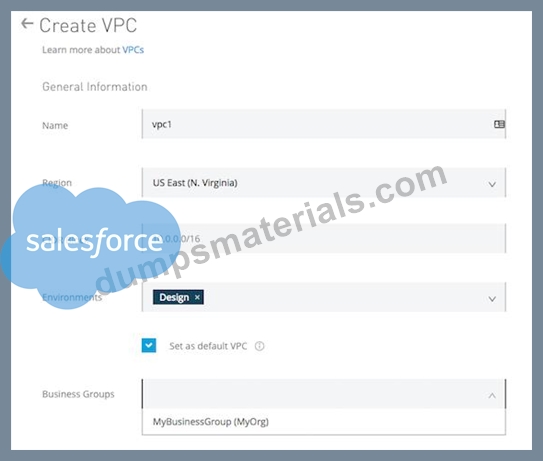
that each CloudHub environment requires a separate Anypoint VPC. Once an Anypoint VPC is created, we can choose a same VPC by multiple environments. However, it is generally a best and recommended practice to always have seperate Anypoint VPCs for Non-Prod and Prod environments.
>> We use Anypoint VPN to link the underlying AWS VPC to an on-premises (non AWS) private network. NOT VPC Peering.
Reference:
Only true statement in the given choices is that the traffic between Mule applications deployed to an Anypoint VPC and on-premises systems can stay within a private network.
https://docs.mulesoft.com/runtime-manager/vpc-connectivity-methods-concept
NEW QUESTION # 45
A company is using an on-prem cluster in the data center as a runtime plane and MuleSoft-hosted control plane.
How can the company monitor the detailed performance metrics on the Mule applications deployed to the cluster from the control plane?
- A. Monitoring Agent must be installed on each node in the cluster
- B. The settings of the Monitoring section in the control plane must be updated to enable detailed logging on the metrics to be captured
- C. Due to the potential performance impact on the runtime nodes, the Monitoring agent should be installed on a separate server
- D. There is no action needed as the on-prem runtime automatically sends the performance data to the control plane
Answer: A
Explanation:
Monitoring On-Premise Mule Applications:
For Mule applications deployed on an on-premises cluster, monitoring detailed performance metrics requires communication with the MuleSoft-hosted control plane. The control plane, when used with on-premises runtimes, relies on Anypoint Monitoring and requires a Monitoring Agent to gather and send detailed performance metrics.
Setting Up Monitoring:
To enable detailed metrics, the Monitoring Agent must be installed on each node in the cluster where Mule applications are deployed. This agent collects data on memory usage, CPU load, response times, and other metrics, and sends it to the control plane for aggregation and visualization.
Evaluating the Options:
Option A: Updating settings in the control plane alone does not enable detailed monitoring; the agent must be installed on each node to capture detailed metrics.
Option B (Correct Answer): Installing the Monitoring Agent on each node ensures that each runtime node in the cluster can send its metrics to the control plane, enabling detailed monitoring.
Option C: Installing the agent on a separate server would not be effective, as each node in the cluster needs to independently report its metrics to ensure full visibility.
Option D: The on-prem runtime does not automatically send detailed metrics to the control plane without the Monitoring Agent installed.
Conclusion:
Option B is the correct answer, as installing the Monitoring Agent on each node is essential for detailed performance monitoring of on-prem applications in a cluster.
Refer to MuleSoft's documentation on configuring Anypoint Monitoring for on-premises deployments and using the Monitoring Agent.
NEW QUESTION # 46
A Platinum customer uses the U.S. control plane and deploys applications to CloudHub in Singapore with a default log configuration.
The compliance officer asks where the logs and monitoring data reside?
- A. Logs are held in:Singapore and monitoring data is held in the United States
- B. Logs and monitoring data are held in the United States
- C. Logs are held in the United States and monitoring data is held in Singapore
- D. Logs and monitoring data are held in Singapore
Answer: B
Explanation:
For applications deployed on CloudHub in a foreign region (e.g., Singapore), MuleSoft handles log and monitoring data in the region where the control plane resides. This data storage policy is standard for CloudHub deployments to maintain centralized log and monitoring data.
Data Location:
For a U.S.-based control plane, all logs and monitoring data are stored in the United States, regardless of the deployment region.
Although the application itself runs in Singapore, data related to application performance and logs is not localized to the deployment region.
of Correct Answer (B):
Since the control plane is based in the United States, all operational data like logs and monitoring will also be stored there, ensuring compliance with MuleSoft's data handling policies.
of Incorrect Options:
Option A and D are incorrect because MuleSoft does not store logs or monitoring data in the application deployment region when the control plane is located in the United States.
Option C suggests mixed storage, which does not align with MuleSoft's data policy structure.
Reference
For details on data residency in CloudHub deployments, refer to MuleSoft's documentation on CloudHub control planes and data handling policies.
NEW QUESTION # 47
A customer has an ELA contract with MuleSoft. An API deployed to CloudHub is consistently experiencing performance issues. Based on the root cause analysis, it is determined that autoscaling needs to be applied.
How can this be achieved?
- A. Configure a policy based on CPU usage so that CloudHub auto-adjusts the number of workers/replicas (horizontal scaling)
- B. Configure a policy so that when the response time reaches a certain threshold the worker/replica type increases (vertical scaling)
- C. Configure a policy so that when the number of HTTP requests reaches a certain threshold the number of workers/replicas increases (horizontal scaling)
- D. Configure two separate policies: When CPU and memory reach certain threshold, increase the worker/replica type (vertical sealing) and the number of workers/replicas (horizontal sealing)
Answer: A
Explanation:
In MuleSoft CloudHub, autoscaling is essential to managing application load efficiently. CloudHub supports horizontal scaling based on CPU usage, which is well-suited to applications experiencing variable demand and needing responsive resource allocation.
Autoscaling on CloudHub:
Horizontal scaling increases the number of workers in response to CPU usage thresholds, allowing the application to handle higher loads dynamically. This approach improves performance without downtime or manual intervention.
Why Option C is Correct:
Setting up autoscaling based on CPU usage aligns with MuleSoft's best practices for scalable and responsive applications on CloudHub, particularly in an environment with fluctuating load patterns.
Option C correctly leverages CloudHub's autoscaling features based on resource metrics, which are part of CloudHub's managed scaling solutions.
of Incorrect Options:
Option A (based on HTTP request thresholds) and Option B (separate policies for CPU and memory) do not represent CloudHub's recommended scaling practices.
Option D suggests vertical scaling based on response time, which is not how CloudHub handles autoscaling.
Reference
For more on CloudHub's autoscaling configuration, refer to MuleSoft documentation on CloudHub autoscaling policies.
NEW QUESTION # 48
An API is protected with a Client ID Enforcement policy and uses the default configuration. Access is requested for the client application to the API, and an approved contract now exists between the client application and the API How can a consumer of this API avoid a 401 error "Unauthorized or invalid client application credentials"?
- A. Send the obtained: client_id and client_secret in the request body
- B. Send the obtained token as a header in every call
- C. Send the obtained clent_id and client_secret in the header of every API Request call
- D. Send the obtained clent_id and clent_secret as URI parameters in every call
Answer: D
Explanation:
When using the Client ID Enforcement policy with default settings, MuleSoft expects the client_id and client_secret to be provided in the URI parameters of each request. This policy is typically used to control and monitor access by validating that each request has valid credentials. Here's how to avoid a 401 Unauthorized error:
URI Parameters Requirement:
The default configuration for the Client ID Enforcement policy requires the client_id and client_secret to be included in each request's URI parameters. This is a straightforward way to authenticate API requests without additional configurations.
Why Option C is Correct:
Providing client_id and client_secret in the URI parameters meets the policy's requirements for each request, ensuring authorized access and avoiding the 401 error.
of Incorrect Options:
Option A (sending a token in the header) would be applicable for token-based authentication (like OAuth 2.0), not Client ID Enforcement.
Option B (request body) and Option D (header) are not valid locations for client_id and client_secret under the default configuration of Client ID Enforcement, which expects them in the URI.
Reference
For more details, consult MuleSoft's documentation on Client ID Enforcement policies and expected request configurations
NEW QUESTION # 49
......
The internet is transforming society, and distance is no longer an obstacle. You can download our Mule-Arch-201 exam simulation from our official website, which is a professional platform providing the most professional Mule-Arch-201 practice materials. You can get them within 15 minutes without waiting. What is more, you may think these high quality Mule-Arch-201 Preparation materials require a huge investment on them. Yes, we do invest a lot to ensure that you can receive the best quality and service.
Mule-Arch-201 Exam Outline: https://www.dumpsmaterials.com/Mule-Arch-201-real-torrent.html
- Where To Start Your Salesforce Mule-Arch-201 Exam Preparation? ???? Search for ⇛ Mule-Arch-201 ⇚ on ⮆ www.pdfdumps.com ⮄ immediately to obtain a free download ????Reliable Mule-Arch-201 Test Vce
- Effective Reliable Mule-Arch-201 Real Test - Leader in Qualification Exams - Top Mule-Arch-201: Salesforce Certified MuleSoft Platform Architect ???? Immediately open ⮆ www.pdfvce.com ⮄ and search for ➥ Mule-Arch-201 ???? to obtain a free download ????Mule-Arch-201 Valid Examcollection
- Valid Mule-Arch-201 vce files, Mule-Arch-201 dumps latest ???? Search for 《 Mule-Arch-201 》 and easily obtain a free download on ➽ www.prepawayexam.com ???? ????Reliable Mule-Arch-201 Exam Bootcamp
- Pdfvce Salesforce Mule-Arch-201 Web-based Practice Exam ???? Search for ➡ Mule-Arch-201 ️⬅️ and download it for free on 【 www.pdfvce.com 】 website ????Mule-Arch-201 Exam Guide Materials
- Reliable Mule-Arch-201 Test Vce ???? Mule-Arch-201 Study Dumps ⭐ Reliable Mule-Arch-201 Test Vce ???? Open ➥ www.troytecdumps.com ???? and search for 《 Mule-Arch-201 》 to download exam materials for free ????Mule-Arch-201 Exam Labs
- Professional Reliable Mule-Arch-201 Real Test - Leading Provider in Qualification Exams - Latest updated Mule-Arch-201 Exam Outline ???? Immediately open ▶ www.pdfvce.com ◀ and search for [ Mule-Arch-201 ] to obtain a free download ????Mule-Arch-201 Valid Test Review
- 2026 Mule-Arch-201: Fantastic Reliable Salesforce Certified MuleSoft Platform Architect Real Test ???? Open website 【 www.pdfdumps.com 】 and search for 《 Mule-Arch-201 》 for free download ????Latest Test Mule-Arch-201 Simulations
- Pdfvce Salesforce Mule-Arch-201 Web-based Practice Exam ???? Open ➤ www.pdfvce.com ⮘ and search for ▛ Mule-Arch-201 ▟ to download exam materials for free ????Testking Mule-Arch-201 Exam Questions
- Mule-Arch-201 Valid Examcollection ???? Latest Test Mule-Arch-201 Simulations ???? Mule-Arch-201 Exam Labs ↩ Open ⏩ www.dumpsquestion.com ⏪ and search for 【 Mule-Arch-201 】 to download exam materials for free ????Mule-Arch-201 Test Pattern
- Mule-Arch-201 Practice Exam Fee ???? Reliable Mule-Arch-201 Test Vce ???? Mule-Arch-201 Test Centres ???? Easily obtain ➠ Mule-Arch-201 ???? for free download through ➡ www.pdfvce.com ️⬅️ ????New Mule-Arch-201 Test Vce Free
- Mule-Arch-201 Test Pattern ⏹ Mule-Arch-201 Latest Exam Forum ⬅️ Mule-Arch-201 Exam Labs ???? The page for free download of “ Mule-Arch-201 ” on ⏩ www.prepawaypdf.com ⏪ will open immediately ????New Mule-Arch-201 Test Vce Free
- www.stes.tyc.edu.tw, myportal.utt.edu.tt, myportal.utt.edu.tt, myportal.utt.edu.tt, myportal.utt.edu.tt, myportal.utt.edu.tt, myportal.utt.edu.tt, myportal.utt.edu.tt, myportal.utt.edu.tt, myportal.utt.edu.tt, myportal.utt.edu.tt, myportal.utt.edu.tt, myportal.utt.edu.tt, myportal.utt.edu.tt, myportal.utt.edu.tt, myportal.utt.edu.tt, myportal.utt.edu.tt, myportal.utt.edu.tt, myportal.utt.edu.tt, myportal.utt.edu.tt, myportal.utt.edu.tt, myportal.utt.edu.tt, myportal.utt.edu.tt, myportal.utt.edu.tt, myportal.utt.edu.tt, myportal.utt.edu.tt, myportal.utt.edu.tt, myportal.utt.edu.tt, myportal.utt.edu.tt, myportal.utt.edu.tt, myportal.utt.edu.tt, myportal.utt.edu.tt, myportal.utt.edu.tt, myportal.utt.edu.tt, myportal.utt.edu.tt, myportal.utt.edu.tt, myportal.utt.edu.tt, myportal.utt.edu.tt, myportal.utt.edu.tt, myportal.utt.edu.tt, myportal.utt.edu.tt, www.stes.tyc.edu.tw, www.stes.tyc.edu.tw, myportal.utt.edu.tt, myportal.utt.edu.tt, myportal.utt.edu.tt, myportal.utt.edu.tt, myportal.utt.edu.tt, myportal.utt.edu.tt, myportal.utt.edu.tt, myportal.utt.edu.tt, myportal.utt.edu.tt, myportal.utt.edu.tt, myportal.utt.edu.tt, myportal.utt.edu.tt, myportal.utt.edu.tt, myportal.utt.edu.tt, myportal.utt.edu.tt, myportal.utt.edu.tt, myportal.utt.edu.tt, myportal.utt.edu.tt, myportal.utt.edu.tt, myportal.utt.edu.tt, myportal.utt.edu.tt, myportal.utt.edu.tt, myportal.utt.edu.tt, myportal.utt.edu.tt, myportal.utt.edu.tt, myportal.utt.edu.tt, myportal.utt.edu.tt, myportal.utt.edu.tt, myportal.utt.edu.tt, myportal.utt.edu.tt, myportal.utt.edu.tt, myportal.utt.edu.tt, myportal.utt.edu.tt, myportal.utt.edu.tt, myportal.utt.edu.tt, myportal.utt.edu.tt, myportal.utt.edu.tt, myportal.utt.edu.tt, myportal.utt.edu.tt, myportal.utt.edu.tt, myportal.utt.edu.tt, myportal.utt.edu.tt, myportal.utt.edu.tt, myportal.utt.edu.tt, myportal.utt.edu.tt, myportal.utt.edu.tt, myportal.utt.edu.tt, myportal.utt.edu.tt, myportal.utt.edu.tt, myportal.utt.edu.tt, myportal.utt.edu.tt, myportal.utt.edu.tt, myportal.utt.edu.tt, myportal.utt.edu.tt, myportal.utt.edu.tt, myportal.utt.edu.tt, myportal.utt.edu.tt, myportal.utt.edu.tt, myportal.utt.edu.tt, myportal.utt.edu.tt, myportal.utt.edu.tt, myportal.utt.edu.tt, myportal.utt.edu.tt, myportal.utt.edu.tt, myportal.utt.edu.tt, myportal.utt.edu.tt, myportal.utt.edu.tt, myportal.utt.edu.tt, myportal.utt.edu.tt, myportal.utt.edu.tt, myportal.utt.edu.tt, myportal.utt.edu.tt, myportal.utt.edu.tt, myportal.utt.edu.tt, myportal.utt.edu.tt, myportal.utt.edu.tt, myportal.utt.edu.tt, myportal.utt.edu.tt, myportal.utt.edu.tt, myportal.utt.edu.tt, myportal.utt.edu.tt, myportal.utt.edu.tt, myportal.utt.edu.tt, myportal.utt.edu.tt, myportal.utt.edu.tt, myportal.utt.edu.tt, myportal.utt.edu.tt, myportal.utt.edu.tt, myportal.utt.edu.tt, myportal.utt.edu.tt, myportal.utt.edu.tt, myportal.utt.edu.tt, myportal.utt.edu.tt, myportal.utt.edu.tt, myportal.utt.edu.tt, myportal.utt.edu.tt, myportal.utt.edu.tt, myportal.utt.edu.tt, myportal.utt.edu.tt, myportal.utt.edu.tt, Disposable vapes
BTW, DOWNLOAD part of DumpsMaterials Mule-Arch-201 dumps from Cloud Storage: https://drive.google.com/open?id=1JbByggI6-3onuld8Ulw_H7sn2IeM7lT9