
2026 NEW PMP TEST PATTERN | RELIABLE PMP: PMP - PROJECT MANAGEME
P.S. Free 2026 PMI PMP dumps are available on Google Drive shared by ExamBoosts: https://drive.google.com/open?id=1ZED9STeLOr8YrvhW83be51g6osmigq1N
Owing to the industrious dedication of our experts and other working staff, our PMP study materials grow to be more mature and are able to fight against any difficulties. Our PMP preparation exam have achieved high pass rate in the industry, and we always maintain a 99% pass rate with our endless efforts. We have to admit that behind such a starling figure, there embrace mass investments on our PMP Exam Questions from our company.
Obtaining the PMI PMP certification is a significant achievement for any project management professional. It demonstrates a commitment to excellence and a dedication to continuous learning and professional development. It also opens up new career opportunities and enhances a professional's earning potential. With the release of the updated PMP Exam in 2023, professionals will have the opportunity to validate their knowledge and skills in project management and stay at the forefront of the profession.
PMP Latest Braindumps Ppt | PMP Latest Exam Pdf
The 24/7 support team is just an e-mail away for our customers so that they can contact us anytime. Our team will solve all of their issues as quickly as possible. Free demos and up to 1 year of free updates of our Sitecore Exams are also available at ExamBoosts. Buy updated and Real PMP Exam Questions now and earn your dream PMP certification with ExamBoosts!
PMP Exam Domains
The content of the PMI PMP Exam includes five domains that cover all the five crucial stages of managing projects. These are listed below together with the percentage showing the weight of each topic:
- Closing (7%).
- Initiation (13%);
- Planning (24%);
- Controlling and Monitoring (25%);
- Executing (31%);
PMI PMP - Project Management Professional (2026) Sample Questions (Q154-Q159):
NEW QUESTION # 154
The following is a network diagram for a project.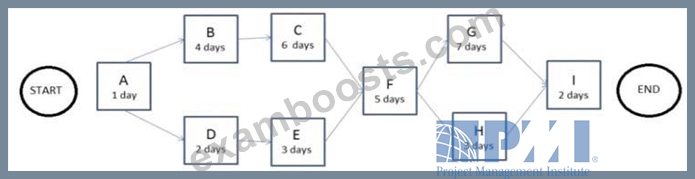
How many possible paths are identified for this project?
- A. 0
- B. 1
- C. 2
- D. 3
Answer: A
NEW QUESTION # 155
During your project meeting, a problem was discussed with one of the key stakeholders, and a resolution to the problem was reached. Sometime after the meeting, you received an email from him saying that he had changed his mind about the solution that was reached and needed to resurface the problem. The solution reached during the initial project meeting is a result of which of the following conflict resolution techniques?
- A. Compromise/Reconcile
- B. Smooth/Accommodate
- C. Withdraw/Avoid
- D. Force/Direct
Answer: B
NEW QUESTION # 156
During a project planning meeting, the customer is not sure how to build a brand new product and is worried about extra costs and work.
The customer is asking the project manager for guidance.
What should the project manager do?
- A. In the planning meeting, focus on releasing a minimum viable product (MVP) quickly and getting feedback from the end users.
- B. Schedule a brainstorming session and select the top ten most important requirements.
- C. Wait to start the project execution phase until all requirements and acceptance criteria are clear.
- D. Ask the customer to include all of the requirements in the project charter to officially start the project planning phase.
Answer: A
Explanation:
This answer is based on the concept of adaptive life cycle or agile project management, which is one of the approaches to managing projects in the PMBOK Guide1. Adaptive life cycle is suitable for projects that have high uncertainty, changing requirements, and complex or innovative products1. The main characteristics of adaptive life cycle are:
* Delivering products in iterations or increments, each with a fixed duration and scope1.
* Seeking frequent feedback from customers and stakeholders to validate the product value and quality1.
* Embracing changes and responding to them quickly and effectively1.
* Empowering the project team to make decisions and collaborate with each other1.
A minimum viable product (MVP) is a version of the product that has enough features to satisfy the initial needs of the customers and stakeholders, and to provide feedback for future development2. By focusing on releasing an MVP quickly, the project manager can:
* Reduce the risk of wasting time and resources on building a product that does not meet the customer's expectations or needs2.
* Increase the customer's satisfaction and engagement by involving them in the product development process2.
* Learn from the feedback and data collected from the MVP and use them to improve the product in the next iteration2.
* Adapt to the changing requirements and market conditions by delivering value incrementally2.
Therefore, option D is the best answer, as it aligns with the adaptive life cycle approach and the benefits of MVP. Option A is not a good answer, as it implies a predictive life cycle or waterfall project management, which is more suitable for projects that have low uncertainty, stable requirements, and well-defined products1. Waiting to start the project execution phase until all requirements and acceptance criteria are clear can result in:
* Missing the opportunity to deliver value early and often to the customers and stakeholders1.
* Increasing the risk of scope creep, change requests, and rework due to changing customer needs or expectations1.
* Reducing the flexibility and responsiveness of the project team to adapt to changes1.
* Limiting the collaboration and communication between the project team and the customers and stakeholders1.
Option B is also not a good answer, as it assumes that the customer knows all of the requirements at the beginning of the project, which is unlikely for a brand new product. Asking the customer to include all of the requirements in the project charter can lead to:
* Creating a rigid and unrealistic scope that does not reflect the customer's actual needs or preferences3.
* Overwhelming the customer and the project team with too many details and specifications that may not be relevant or necessary3.
* Ignoring the feedback and learning opportunities that can arise during the project execution phase3.
* Reducing the chances of innovation and creativity by restricting the product features and functions3.
Option C is a better answer than option A and B, as it involves the customer in the requirement elicitation process and prioritizes the most important requirements. However, it is still not the best answer, as it does not address the customer's concern about extra costs and work. Scheduling a brainstorming session and selecting the top ten most important requirements can still result in:
* Spending too much time and resources on planning and analysis, instead of delivering value and testing assumptions.
* Failing to validate the requirements with the end users and other stakeholders, who may have different needs or expectations.
* Missing the opportunity to learn from the feedback and data collected from the product delivery and use.
* Delaying the adaptation and improvement of the product based on the changing requirements and market conditions.
References:
1: A Guide to the Project Management Body of Knowledge (PMBOK Guide) - Sixth Edition, Chapter 1 and
4, Project Management Institute, 2017. 2: The Lean Startup: How Today's Entrepreneurs Use Continuous Innovation to Create Radically Successful Businesses, Chapter 3 and 6, Eric Ries, 2011. 3: Software Requirements, Third Edition, Chapter 2 and 3, Karl Wiegers and Joy Beatty, 2013. : Agile Project Management with Scrum, Chapter 1 and 2, Ken Schwaber, 2004.
NEW QUESTION # 157
In an organization transitioning to agile, the project team is in the norming phase. Team members became uncomfortable when the project manager assigned reporting responsibilities to the newest team member. Team members began questioning the project manager's decision. What should the project manager do?
- A. Remind team members that administrative decisions are the project manager's duties.
- B. Revoke the delegated responsibilities to keep the team members harmonious.
- C. Explain the rationale for delegating responsibilities to team members.
- D. Invite team members to volunteer for roles for which they feel qualified.
Answer: C
NEW QUESTION # 158
You are in the process of planning a project and found that stakeholders often have varying objectives and requirements which makes it hard create a plan in such way that all objectives will be met. What is probably most helpful to ensure comm. understanding?
- A. Ask the project stakeholders to build focus groups to discuss and remedy conflicting interests.
- B. Use your authorization as the project manager to clearly prioritize the different objectives.
- C. Let each stakeholder write a statement of work, merge the documents to a project scope statement.
- D. Create an exhaustive document describing your point of view and ask stakeholders to review it.
Answer: A
NEW QUESTION # 159
......
PMP Latest Braindumps Ppt: https://www.examboosts.com/PMI/PMP-practice-exam-dumps.html
- Reliable PMP Braindumps Questions ???? PMP Study Center ???? PMP Valid Examcollection ???? Easily obtain ▶ PMP ◀ for free download through “ www.prep4away.com ” ????PMP Updated Demo
- Pass Guaranteed Quiz 2026 PMI Latest PMP: New PMP - Project Management Professional (2026) Test Pattern ???? Easily obtain free download of 「 PMP 」 by searching on ☀ www.pdfvce.com ️☀️ ????Brain PMP Exam
- Quiz PMI - PMP –High-quality New Test Pattern ???? Search for ➥ PMP ???? and easily obtain a free download on ⮆ www.exam4labs.com ⮄ ????Vce PMP Free
- PMP Study Materials - PMP Actual Exam - PMP Test Dumps ???? Simply search for ☀ PMP ️☀️ for free download on 《 www.pdfvce.com 》 ????PMP Valid Examcollection
- New PMP Test Pattern - Latest Latest Braindumps Ppt Ensure you High Pass Rate for PMP: PMP - Project Management Professional (2026) Easily ⚛ Open [ www.testkingpass.com ] and search for ▷ PMP ◁ to download exam materials for free ????PMP Relevant Answers
- Pass Guaranteed Quiz 2026 PMI Latest PMP: New PMP - Project Management Professional (2026) Test Pattern ???? Search for { PMP } and easily obtain a free download on ✔ www.pdfvce.com ️✔️ ????Valid PMP Exam Notes
- PMP Certification Test Questions ???? PMP Certification Test Questions ⏫ PMP Updated Demo ???? Search for { PMP } and easily obtain a free download on ( www.prepawayete.com ) ????PMP Updated Demo
- PMP Relevant Answers ???? Reliable PMP Braindumps Questions ???? Reliable PMP Exam Topics ???? The page for free download of ▶ PMP ◀ on { www.pdfvce.com } will open immediately ????PMP Practice Exams Free
- PMP Updated Demo ☘ Vce PMP Free ???? PMP Study Center ???? Copy URL ➽ www.prepawaypdf.com ???? open and search for [ PMP ] to download for free ????PMP Relevant Answers
- PMP Practice Exams Free ???? PMP Certification Test Questions ???? PMP Relevant Answers ???? Easily obtain free download of ▷ PMP ◁ by searching on ▷ www.pdfvce.com ◁ ????Latest PMP Exam Answers
- PMI PMP PDF Format for Easy Access ???? Go to website ➽ www.pdfdumps.com ???? open and search for ▶ PMP ◀ to download for free ????Reliable PMP Exam Topics
- parsif.al, myportal.utt.edu.tt, myportal.utt.edu.tt, myportal.utt.edu.tt, myportal.utt.edu.tt, myportal.utt.edu.tt, myportal.utt.edu.tt, myportal.utt.edu.tt, myportal.utt.edu.tt, myportal.utt.edu.tt, myportal.utt.edu.tt, myportal.utt.edu.tt, myportal.utt.edu.tt, myportal.utt.edu.tt, myportal.utt.edu.tt, myportal.utt.edu.tt, myportal.utt.edu.tt, myportal.utt.edu.tt, myportal.utt.edu.tt, myportal.utt.edu.tt, myportal.utt.edu.tt, www.stes.tyc.edu.tw, myportal.utt.edu.tt, myportal.utt.edu.tt, myportal.utt.edu.tt, myportal.utt.edu.tt, myportal.utt.edu.tt, myportal.utt.edu.tt, myportal.utt.edu.tt, myportal.utt.edu.tt, myportal.utt.edu.tt, myportal.utt.edu.tt, myportal.utt.edu.tt, myportal.utt.edu.tt, myportal.utt.edu.tt, myportal.utt.edu.tt, myportal.utt.edu.tt, myportal.utt.edu.tt, myportal.utt.edu.tt, myportal.utt.edu.tt, myportal.utt.edu.tt, myportal.utt.edu.tt, www.stes.tyc.edu.tw, www.stes.tyc.edu.tw, myportal.utt.edu.tt, myportal.utt.edu.tt, myportal.utt.edu.tt, myportal.utt.edu.tt, myportal.utt.edu.tt, myportal.utt.edu.tt, myportal.utt.edu.tt, myportal.utt.edu.tt, myportal.utt.edu.tt, myportal.utt.edu.tt, myportal.utt.edu.tt, myportal.utt.edu.tt, myportal.utt.edu.tt, myportal.utt.edu.tt, myportal.utt.edu.tt, myportal.utt.edu.tt, myportal.utt.edu.tt, myportal.utt.edu.tt, myportal.utt.edu.tt, myportal.utt.edu.tt, www.stes.tyc.edu.tw, international.projectwet.org, www.stes.tyc.edu.tw, Disposable vapes
P.S. Free 2026 PMI PMP dumps are available on Google Drive shared by ExamBoosts: https://drive.google.com/open?id=1ZED9STeLOr8YrvhW83be51g6osmigq1N