
RELIABLE 4A0-D03 EXAM SAMPLE | SAMPLE 4A0-D03 QUESTIONS PDF
The Braindumpsqa is one of the leading platforms that has been offering real and valid Nokia SR Linux EVPN and Data Center Interconnect (4A0-D03) exam practice test questions. These Nokia SR Linux EVPN and Data Center Interconnect (4A0-D03) exam questions are designed and verified by Nokia 4A0-D03 subject matter experts. They work closely together and put all their expertise to check the Nokia 4A0-D03 exam questions one by one.
Nokia 4A0-D03 Exam Syllabus Topics:
| Section | Objectives |
|---|---|
| Topic 1: SR Linux Architecture and Fundamentals | - Network operating system concepts and containerized routing functions - SR Linux system architecture and components - Configuration and operational models |
| Topic 2: BGP and Routing in Data Center Environments | - BGP EVPN address families - Interoperability between routing domains - Route reflection and scaling design |
| Topic 3: Operations, Troubleshooting and Best Practices | - Monitoring SR Linux and EVPN environments - Troubleshooting BGP EVPN and VXLAN issues - Network optimization and scaling considerations |
| Topic 4: Data Center Interconnect (DCI) | - L2 and L3 DCI design patterns - Redundancy and high availability strategies - EVPN-based interconnect solutions |
| Topic 5: EVPN and VXLAN Data Center Fabric | - VXLAN data plane and encapsulation - EVPN route types and MAC/IP advertisement - EVPN control plane fundamentals |
>> Reliable 4A0-D03 Exam Sample <<
Sample 4A0-D03 Questions Pdf - New 4A0-D03 Test Price
The modern Nokia world is changing its dynamics at a fast pace. To stay and compete in this challenging market, you have to learn and enhance your in-demand skills. Fortunately, with the Nokia SR Linux EVPN and Data Center Interconnect (4A0-D03) certification exam you can do this job nicely and quickly. To do this you just need to enroll in the Nokia 4A0-D03 Certification Exam and put all your efforts to pass the Nokia SR Linux EVPN and Data Center Interconnect (4A0-D03) certification exam.
Nokia SR Linux EVPN and Data Center Interconnect Sample Questions (Q55-Q60):
NEW QUESTION # 55
Which of the following statements about PE-CE routing is FALSE?
- A. There are two methods to implement routing between the PE and CE, static and dynamic.
- B. BGP is the preferred option for PE-CE routing as it scales better than static routing.
- C. The CE advertises BGP EVPN route type 5 updates to the PE and the PE forwards to other PEs.
- D. eBGP is preferred which means that the PE and CE are required to be in different autonomous systems.
Answer: C
Explanation:
Comprehensive and Detailed 150 to 250 words of Explanation From [SR Linux EVPN and Data Center Interconnect/Course Guide/topics]:
PE-CE routing is the mechanism used to exchange customer prefix reachability between a provider edge or data center leaf and the attached customer edge router. It can be implemented statically or dynamically. Static routing is operationally simple but does not scale well when many prefixes or frequent changes are involved. BGP is preferred for larger deployments because it supports policy, route filtering, attributes, and automated advertisement of changing reachability. In most EVPN PE-CE designs, eBGP is preferred because it creates a clean routing boundary between the PE and CE, with each device operating in a different autonomous system. Option D is false because the CE does not advertise BGP EVPN route type 5 updates to the PE. The CE advertises ordinary IPv4 or IPv6 unicast prefixes over the PE-CE routing session. The PE then imports those customer prefixes into the IP-VRF and advertises them into the EVPN overlay as route type 5 IP Prefix routes toward other PEs. This distinction matters: EVPN signaling is a PE-to-PE overlay function, not a CE-originated EVPN control-plane role. Reference: PE-CE routing, eBGP, EVPN RT-5 prefix advertisement.
NEW QUESTION # 56
Leaf routers are configured to support Layer 2 multi-homing all-active mode.
Which of the following statements is FALSE?
- A. The 2nd through 7th octets of the ESI must not be all zeros.
- B. The Ethernet segment must be administratively enabled.
- C. All of the sub-interfaces of the LAG must be configured in the Ethernet segment.
- D. The multi-homing mode of all-active must be configured for the Ethernet segment.
Answer: A
Explanation:
Comprehensive and Detailed 150 to 250 words of Explanation From [SR Linux EVPN and Data Center Interconnect/Course Guide/topics]:
For Layer 2 all-active EVPN multi-homing on SR Linux, the Ethernet Segment configuration is the control-plane anchor that binds the redundant access attachment to EVPN. The relevant LAG subinterfaces must be associated with the Ethernet Segment so that the PE can advertise the segment correctly and apply split-horizon and aliasing behavior. The Ethernet Segment must also be administratively enabled; otherwise, the PE will not participate properly in ES discovery and DF procedures. The multi-homing mode must be set to all-active to permit forwarding through multiple attached leaf routers and support host-side LAG operation. The false statement is option B. The Ethernet Segment Identifier has a defined structure, and the blanket statement that the 2nd through 7th octets "must not be all zeros" is not a valid requirement as stated. What matters operationally is that the ESI uniquely identifies the same multi-homed Ethernet Segment across participating PEs and is consistently configured where required. The ESI must be non-zero as a meaningful segment identifier, but the specific octet restriction in the option is not the SR Linux all-active configuration rule. Reference: SR Linux L2 EVPN all-active multi-homing, Ethernet Segment configuration, LAG association.
NEW QUESTION # 57
Consider the exhibit.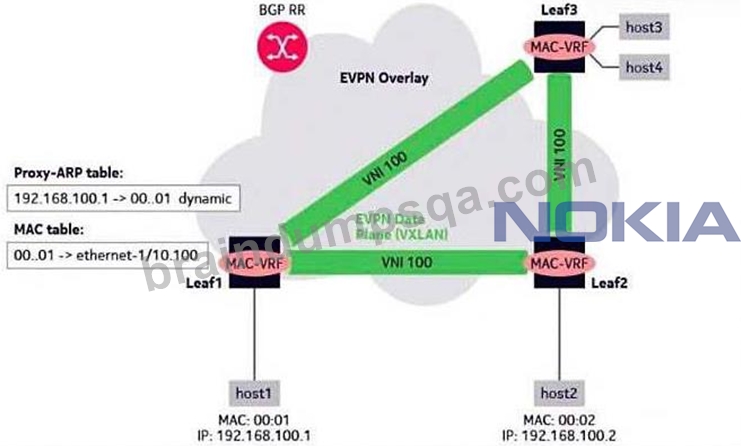
Leaf-1 has received an ARP request from host-1 for host-2. Leaf-1 has added host-1's MAC address in its MAC table and host-1's MAC/IP addresses in its proxy-ARP table.
Which of the following steps is FALSE?
- A. The remote peers generate a gratuitous ARP towards their directly connected hosts to announce the learned IP/MAC mapping information.
- B. The remote peers ignore the EVPN update with the IP address set to 0.0.0.0 and use the update with the IP address set to 192.168.100.1 to populate their MAC forwarding tables.
- C. Leaf-1 sends a route-type 2 EVPN update with host-1's MAC with the IP address set to 0.0.0.0 to the remote peers.
- D. Leaf-1 sends a route-type 2 EVPN update with host-1's MAC with the IP address set to 192.168.100.1 to the remote peers.
Answer: C
Explanation:
Comprehensive and Detailed 150 to 250 words of Explanation From [SR Linux EVPN and Data Center Interconnect/Course Guide/topics]:
When Leaf-1 receives an ARP request from Host-1, it learns the source MAC address in the local MAC table and learns the source IP/MAC binding in the proxy ARP table. For EVPN distribution, the relevant control-plane advertisement is an EVPN route type 2 MAC/IP advertisement containing Host-1's MAC and the actual host IP address, 192.168.100.1. This allows remote PEs to populate their EVPN-derived forwarding and proxy ARP state with the correct endpoint binding. Option A is false because advertising the host MAC with the IP address set to 0.0.0.0 does not represent the learned MAC/IP binding required for proxy ARP synchronization. A MAC-only RT-2 advertisement may exist in EVPN contexts, but the question specifically states that Leaf-1 has learned the MAC/IP binding through ARP and is distributing that information. Therefore, the valid advertisement must include the real host IP address. Remote PEs use the MAC/IP route to learn the endpoint, not an all-zero IP placeholder for this proxy ARP learning event. Reference: EVPN RT-2 MAC/IP advertisement, proxy ARP table population, endpoint synchronization.
NEW QUESTION # 58
Consider the exhibit.
dcgw10 is a Nokia 7750SR and is used as the integrated gateway.
Which of the following is NOT configured in VPLS 100 on dcgw10?
- A. The EVI to be used by the VPLS.
- B. A VXLAN instance with the VNI for the VPLS.
- C. A BGP instance with two unique route targets.
- D. The BGP instance bound to the MPLS tunnels toward dcgw20.
Answer: B
Explanation:
Comprehensive and Detailed 150 to 250 words of Explanation From [SR Linux EVPN and Data Center Interconnect/Course Guide/topics]:
For Layer 2 data center interconnect using an integrated gateway, VPLS 100 on the Nokia 7750 SR represents the WAN-side Layer 2 VPN service. The VPLS requires an EVI because EVPN uses the EVI to identify the L2 service instance in the control plane. It also requires BGP EVPN signaling with the appropriate route targets so the local and remote service instances can import the correct EVPN routes. Because the service is transported across the WAN, the BGP/EVPN instance must be associated with the MPLS transport tunnels toward the remote gateway, dcgw20. A VXLAN instance with a VNI is not configured in the 7750 SR VPLS 100 for this integrated WAN gateway service. The VXLAN/VNI mapping is used inside the SR Linux data center fabric where MAC-VRF services are transported over VXLAN. On the WAN side, the VPLS service is carried using MPLS/EVPN mechanisms, not a VXLAN VNI configured directly under the VPLS. Reference: integrated gateway DCI, L2 EVPN/VPLS interworking, EVI and route-target operation.
NEW QUESTION # 59
Which of the following is always found in an extended community associated with an EVPN update?
- A. The VXLAN network ID
- B. The EVPN route type
- C. The route target
- D. The AFI/SAFI
Answer: C
Explanation:
Comprehensive and Detailed 150 to 250 words of Explanation From [SR Linux EVPN and Data Center Interconnect/Course Guide/topics]:
The route target is the extended community consistently associated with EVPN updates to control route import and export between EVPN instances. In SR Linux EVPN services, route targets determine which MAC-VRF or IP-VRF should import a received EVPN route. This is essential for tenant separation because multiple tenants may use overlapping MAC or IP address spaces while sharing the same physical fabric and BGP control plane. The AFI/SAFI is not an extended community; it identifies the BGP address family and subsequent address family used to carry EVPN NLRI. The EVPN route type is also not an extended community; it is part of the EVPN NLRI structure and identifies whether the route is RT-1, RT-2, RT-3, RT-4, RT-5, and so on. The VXLAN network ID may be carried or inferred through service and encapsulation-specific attributes, but it is not universally present as the required extended community in every EVPN update. The route target is the mandatory policy element that enables receiving PEs to place EVPN routes into the correct service context. Reference: EVPN extended communities, route-target import/export policy, tenant service identification.
NEW QUESTION # 60
......
The experts of our company are checking whether our 4A0-D03 test quiz is updated or not every day. We can guarantee that our 4A0-D03 exam torrent will keep pace with the digitized world by the updating system. We will try our best to help our customers get the latest information about study materials. If you are willing to buy our 4A0-D03 Exam Torrent, there is no doubt that you can have the right to enjoy the updating system. Once our 4A0-D03 exam dumps are updated, you will receive the newest information of our 4A0-D03 test quiz in time. So quickly buy our 4A0-D03 exam prep now!
Sample 4A0-D03 Questions Pdf: https://www.braindumpsqa.com/4A0-D03_braindumps.html
- Trustworthy Reliable 4A0-D03 Exam Sample - Guaranteed Nokia 4A0-D03 Exam Success with Accurate Sample 4A0-D03 Questions Pdf ⛲ Search for 「 4A0-D03 」 and download it for free immediately on ▛ www.easy4engine.com ▟ ????4A0-D03 Exam Simulator Online
- 100% Pass Quiz 2026 Nokia 4A0-D03: Newest Reliable Nokia SR Linux EVPN and Data Center Interconnect Exam Sample ???? Open 「 www.pdfvce.com 」 and search for ( 4A0-D03 ) to download exam materials for free ????Top 4A0-D03 Questions
- 100% Pass Quiz Valid Nokia - 4A0-D03 - Reliable Nokia SR Linux EVPN and Data Center Interconnect Exam Sample ???? Open website ▶ www.practicevce.com ◀ and search for 《 4A0-D03 》 for free download ????Review 4A0-D03 Guide
- 4A0-D03 Instant Download ???? Testking 4A0-D03 Learning Materials ???? 4A0-D03 Positive Feedback ???? Search for ➥ 4A0-D03 ???? and download exam materials for free through ➽ www.pdfvce.com ???? ????Review 4A0-D03 Guide
- 4A0-D03 Positive Feedback ⛰ 4A0-D03 Valid Exam Book ???? Practice 4A0-D03 Test Engine ???? Open website ▷ www.prepawayexam.com ◁ and search for ▛ 4A0-D03 ▟ for free download ????4A0-D03 Certificate Exam
- Providing You High Pass-Rate Reliable 4A0-D03 Exam Sample with 100% Passing Guarantee ???? Simply search for ▷ 4A0-D03 ◁ for free download on { www.pdfvce.com } ⬛Reliable 4A0-D03 Exam Answers
- 4A0-D03 Exam Simulator Online ☔ Review 4A0-D03 Guide ???? 4A0-D03 Official Study Guide ???? Enter ⇛ www.testkingpass.com ⇚ and search for ➤ 4A0-D03 ⮘ to download for free ????4A0-D03 Exam Overviews
- 4A0-D03 Official Study Guide ???? Practice 4A0-D03 Test Engine ???? Review 4A0-D03 Guide ???? Open website ➥ www.pdfvce.com ???? and search for ☀ 4A0-D03 ️☀️ for free download ????4A0-D03 Valid Exam Forum
- 4A0-D03 Valid Exam Book ???? 4A0-D03 Positive Feedback ???? 4A0-D03 Exam Simulator Online ???? Easily obtain 「 4A0-D03 」 for free download through ▛ www.practicevce.com ▟ ????4A0-D03 Test Collection Pdf
- Pdfvce Provides Nokia 4A0-D03 Exam Questions 2026 ???? Download [ 4A0-D03 ] for free by simply searching on ➽ www.pdfvce.com ???? ????Top 4A0-D03 Questions
- 4A0-D03 Valid Exam Book ???? 4A0-D03 Official Study Guide ???? 4A0-D03 Exam Simulator Online ???? ▛ www.prepawayete.com ▟ is best website to obtain ➽ 4A0-D03 ???? for free download ????4A0-D03 Official Study Guide
- myportal.utt.edu.tt, myportal.utt.edu.tt, myportal.utt.edu.tt, myportal.utt.edu.tt, myportal.utt.edu.tt, myportal.utt.edu.tt, myportal.utt.edu.tt, myportal.utt.edu.tt, myportal.utt.edu.tt, myportal.utt.edu.tt, myportal.utt.edu.tt, myportal.utt.edu.tt, myportal.utt.edu.tt, myportal.utt.edu.tt, myportal.utt.edu.tt, myportal.utt.edu.tt, myportal.utt.edu.tt, myportal.utt.edu.tt, myportal.utt.edu.tt, myportal.utt.edu.tt, myportal.utt.edu.tt, myportal.utt.edu.tt, myportal.utt.edu.tt, myportal.utt.edu.tt, myportal.utt.edu.tt, myportal.utt.edu.tt, myportal.utt.edu.tt, myportal.utt.edu.tt, myportal.utt.edu.tt, myportal.utt.edu.tt, myportal.utt.edu.tt, myportal.utt.edu.tt, myportal.utt.edu.tt, myportal.utt.edu.tt, myportal.utt.edu.tt, myportal.utt.edu.tt, myportal.utt.edu.tt, myportal.utt.edu.tt, myportal.utt.edu.tt, myportal.utt.edu.tt, myportal.utt.edu.tt, myportal.utt.edu.tt, myportal.utt.edu.tt, myportal.utt.edu.tt, myportal.utt.edu.tt, myportal.utt.edu.tt, myportal.utt.edu.tt, myportal.utt.edu.tt, myportal.utt.edu.tt, myportal.utt.edu.tt, myportal.utt.edu.tt, myportal.utt.edu.tt, myportal.utt.edu.tt, myportal.utt.edu.tt, myportal.utt.edu.tt, myportal.utt.edu.tt, myportal.utt.edu.tt, myportal.utt.edu.tt, myportal.utt.edu.tt, myportal.utt.edu.tt, ifidir.com, myportal.utt.edu.tt, myportal.utt.edu.tt, myportal.utt.edu.tt, myportal.utt.edu.tt, myportal.utt.edu.tt, myportal.utt.edu.tt, myportal.utt.edu.tt, myportal.utt.edu.tt, myportal.utt.edu.tt, myportal.utt.edu.tt, myportal.utt.edu.tt, myportal.utt.edu.tt, myportal.utt.edu.tt, myportal.utt.edu.tt, myportal.utt.edu.tt, myportal.utt.edu.tt, myportal.utt.edu.tt, myportal.utt.edu.tt, myportal.utt.edu.tt, myportal.utt.edu.tt, myportal.utt.edu.tt, myportal.utt.edu.tt, myportal.utt.edu.tt, myportal.utt.edu.tt, myportal.utt.edu.tt, myportal.utt.edu.tt, myportal.utt.edu.tt, myportal.utt.edu.tt, myportal.utt.edu.tt, myportal.utt.edu.tt, myportal.utt.edu.tt, myportal.utt.edu.tt, myportal.utt.edu.tt, myportal.utt.edu.tt, myportal.utt.edu.tt, myportal.utt.edu.tt, myportal.utt.edu.tt, myportal.utt.edu.tt, myportal.utt.edu.tt, myportal.utt.edu.tt, mahsaamini5421.blogspot.com, myportal.utt.edu.tt, myportal.utt.edu.tt, myportal.utt.edu.tt, myportal.utt.edu.tt, myportal.utt.edu.tt, myportal.utt.edu.tt, myportal.utt.edu.tt, myportal.utt.edu.tt, myportal.utt.edu.tt, myportal.utt.edu.tt, myportal.utt.edu.tt, myportal.utt.edu.tt, myportal.utt.edu.tt, myportal.utt.edu.tt, myportal.utt.edu.tt, myportal.utt.edu.tt, myportal.utt.edu.tt, myportal.utt.edu.tt, myportal.utt.edu.tt, myportal.utt.edu.tt, myportal.utt.edu.tt, myportal.utt.edu.tt, myportal.utt.edu.tt, myportal.utt.edu.tt, myportal.utt.edu.tt, myportal.utt.edu.tt, myportal.utt.edu.tt, myportal.utt.edu.tt, myportal.utt.edu.tt, myportal.utt.edu.tt, myportal.utt.edu.tt, myportal.utt.edu.tt, myportal.utt.edu.tt, myportal.utt.edu.tt, myportal.utt.edu.tt, myportal.utt.edu.tt, myportal.utt.edu.tt, myportal.utt.edu.tt, myportal.utt.edu.tt, myportal.utt.edu.tt, myportal.utt.edu.tt, myportal.utt.edu.tt, myportal.utt.edu.tt, myportal.utt.edu.tt, myportal.utt.edu.tt, myportal.utt.edu.tt, myportal.utt.edu.tt, myportal.utt.edu.tt, myportal.utt.edu.tt, myportal.utt.edu.tt, myportal.utt.edu.tt, myportal.utt.edu.tt, myportal.utt.edu.tt, myportal.utt.edu.tt, myportal.utt.edu.tt, myportal.utt.edu.tt, myportal.utt.edu.tt, myportal.utt.edu.tt, myportal.utt.edu.tt, myportal.utt.edu.tt, Disposable vapes