
HOW AI AGENTS ARE PROTECTING BUSINESSES FROM MODERN FRAUD THREAT

Fraud is no longer a series of normal incidents; it is a global, fast-evolving industry in itself. From sophisticated phishing schemes to insider threats and synthetic identity fraud, businesses today face adversaries who are resourceful, patient, and well-funded. Traditional fraud prevention techniques, built on static rules and manual audits, often fail against these dynamic threats.
This is where AI agents for anomaly detection and AI-driven fraud detection systems are stepping in. By combining speed, intelligence, and adaptability, these AI-powered systems offer businesses a robust defense line against modern fraud attempts.
Modern Fraud Landscape
Fraud threats have grown in scale and complexity. Key examples include:
Account Takeover: Cybercriminals exploit stolen credentials for unauthorised access.
Synthetic Identity Fraud: Blending real and fake information to pass KYC processes.
Transaction Manipulation: Numerous low-value, suspicious transactions that appear normal in isolation.
Insider Threats: Employees misusing access for personal gain, often leaving little trace.
Static systems cannot cope with these challenges. Businesses need AI-powered fraud detection systems that evolve as cyber activities evolve.
The Role of AI Agents in Fraud Detection
AI agents are autonomous systems capable of learning, adapting, and acting in real time. Some of their major capabilities are:
1. Behavioral profiling
AI builds dynamic baselines of normal behavior for users, devices, or accounts. Any significant deviation, such as unusual login times or unrecognized devices, can trigger an alert.
Example: If a user always logs in from India during daytime hours but suddenly attempts a large transfer at midnight from another country, the AI agents flag the activity. This level of personalized anomaly detection significantly reduces false positives while improving precision in spotting fraud.
2. Real-time risk scoring
Every transaction is analyzed instantly and assigned a fraud risk score. Suspicious activities can be blocked, flagged, or subjected to additional authentication within milliseconds.
Low-risk events continue seamlessly to maintain the user experience. However, high-risk events can trigger set-up authentication, account locks, or further investigation. This real-time decision-making ensures fraud attempts are blocked before they cause financial damage.
3. Cross-channel & multi-layer correlation
Fraud is not confined to one channel. Attackers may probe weaknesses across mobile apps, websites, APIs, or even call centres. AI agents correlate signals across all these touchpoints.
For instance, multiple small suspicious activities across different accounts may reveal a larger coordinated attack. By connecting fragmented data points, AI exposes patterns that humans would miss.
4.Continuous learning and adaptability
Fraud tactics evolve daily, from synthetic identity creation to bot-driven credential stuffing. AI agents don’t rely solely on pre-programmed patterns; they learn from new fraud cases and adapt accordingly.
New user behaviors, even if unusual but legitimate, are learned and accepted to avoid unnecessary alerts. This constant adaptation keeps the AI-driven fraud detection system relevant and effective over time.
5.Advanced anomaly detection
Using unsupervised learning, AI agents identify unknown and suspicious activities without prior labels. For example, if a fraudster invents a new method that has never been seen before, anomaly detection highlights it based on deviations from normal behavior.
This is a powerful safeguard against emerging fraud schemes that evade traditional rule-based detection.
6.Contextual awareness
One of the challenges of AI systems is trust. Modern fraud detection agents are increasingly designed to provide context and explainability. Instead of flagging an event as simply “fraudulent,” the agent provides reasons as an unusual device used, a transfer amount exceeding 5x baseline, or a location mismatch detected.
This helps fraud analysts make faster, more confident decisions while building organizational trust in AI systems.
7. Collaboration with human analysts
AI agents don’t replace human fraud investigators; they augment them. Routine detection, filtering, and scoring are automated. Complex or ambiguous cases are escalated with rich contextual data for human review.
This human-AI collaboration allows teams to focus on the most critical cases, improving efficiency and reducing fatigue from false positives.
Benefits of AI-Powered Fraud Detection Systems
Businesses adopting cybersecurity fraud detection systems powered by AI to gain:
Scalability at Enterprise Speed
AI systems process millions of events in real time without bottlenecks, unlike manual or rule-based detection.
Enhanced Accuracy
By combining supervised and unsupervised learning, false positives are reduced, while sophisticated fraud patterns are flagged with precision.
Adaptation to Complex Threats
Whether it’s money laundering rings or multi-layered identity fraud, AI systems detect fraud at scale by aggregating weak signals into actionable intelligence.
Building Blocks of An AI Fraud Detection System
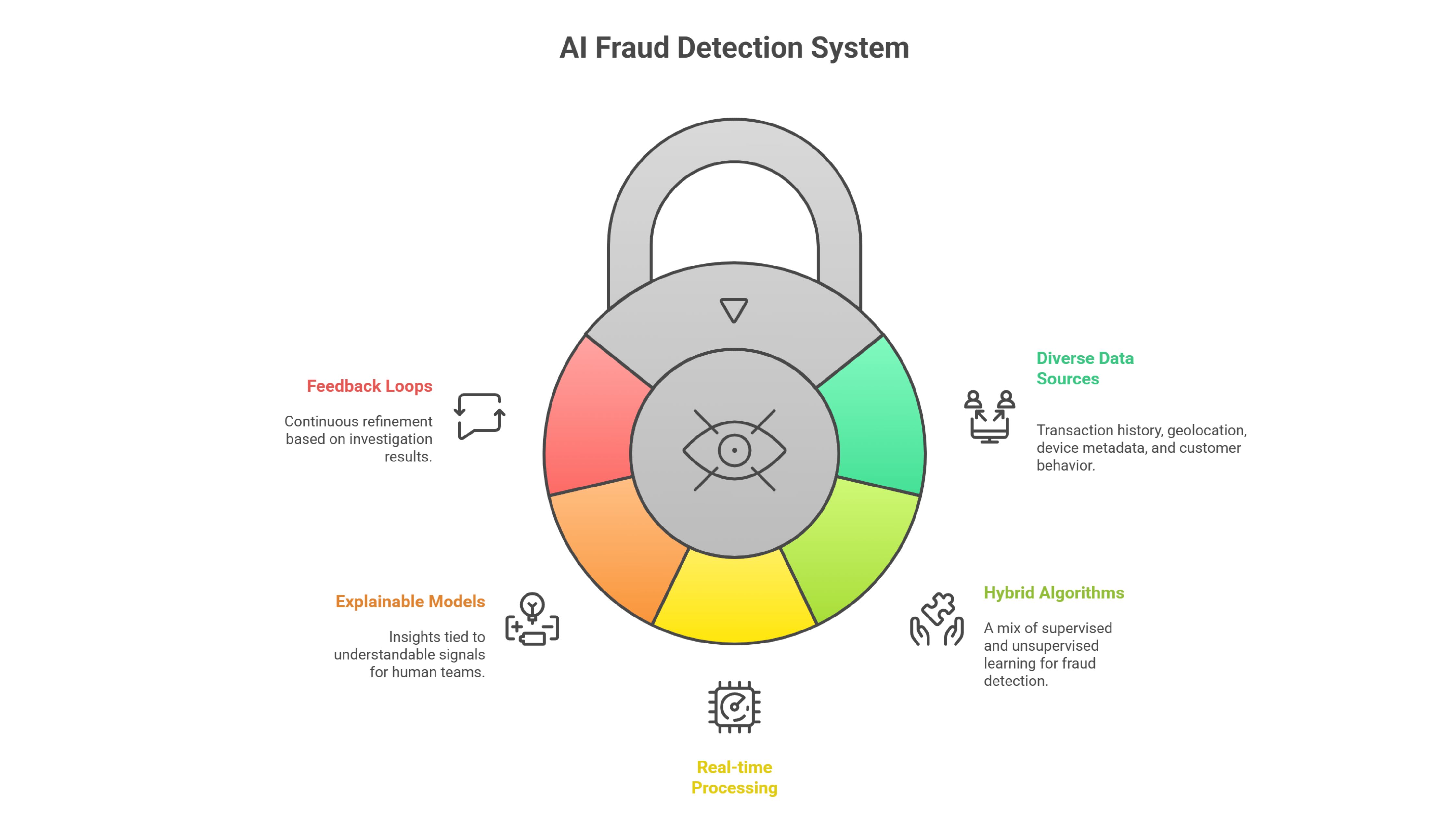
To function effectively, an AI-driven fraud system requires:
1. Diverse data sources
Transaction history, geolocation, device metadata, and customer behavior.
2. Hybrid algorithms
A mix of supervised learning (for known fraud patterns) and unsupervised learning (for anomalies).
3. Real-time processing
Ability to act within milliseconds.
4. Explainable models
Insights tied to understandable signals for human teams.
5. Feedback loops
Continuous refinement based on investigation results.
Challenges in AI and Fraud Detection
While powerful, AI systems face certain challenges:
- Bias & Fairness – Models may over-flag certain user groups without fairness controls.
- Privacy Concerns – Must comply with GDPR, CCPA, and other regulations while analyzing sensitive data.
- Adversarial Attacks – Fraudsters may attempt to manipulate AI models with misleading data.
- Operational Integration – Effective deployment requires alignment between AI systems and fraud teams.
With thoughtful design and governance, these challenges can be managed without undermining system efficiency.
The Future of Cybersecurity and Fraud Detection
The revolution of AI-driven fraud detection will be highly autonomous. Here’s how:
End-to-end response: AI agents will not only detect but also take automated countermeasures, such as freezing accounts or triggering MFA.
Cross-channel intelligence: Fraud detection will expand across financial, IoT, healthcare, and supply chain systems.
Proactive threat hunting: Instead of reacting to fraud, AI will detect early signs of organized fraud campaigns before they mature.
Conclusion
Fraud is constantly evolving, so are the tools to fight it. With AI agents for anomaly detection, AI-powered fraud detection systems, and cybersecurity fraud detection technologies, businesses now have the means to stay ahead of modern threats.
Unlike traditional, rule-based systems of the past, today’s AI and fraud detection ecosystem is adaptive, scalable, and context-aware. As AI agents continue to mature, they will not only protect against fraud but also redefine what resilient digital business security looks like.