
VIRTUAL SURGERY PLANNING IN COMPLEX CASES: IMPACT ON ACCURACY
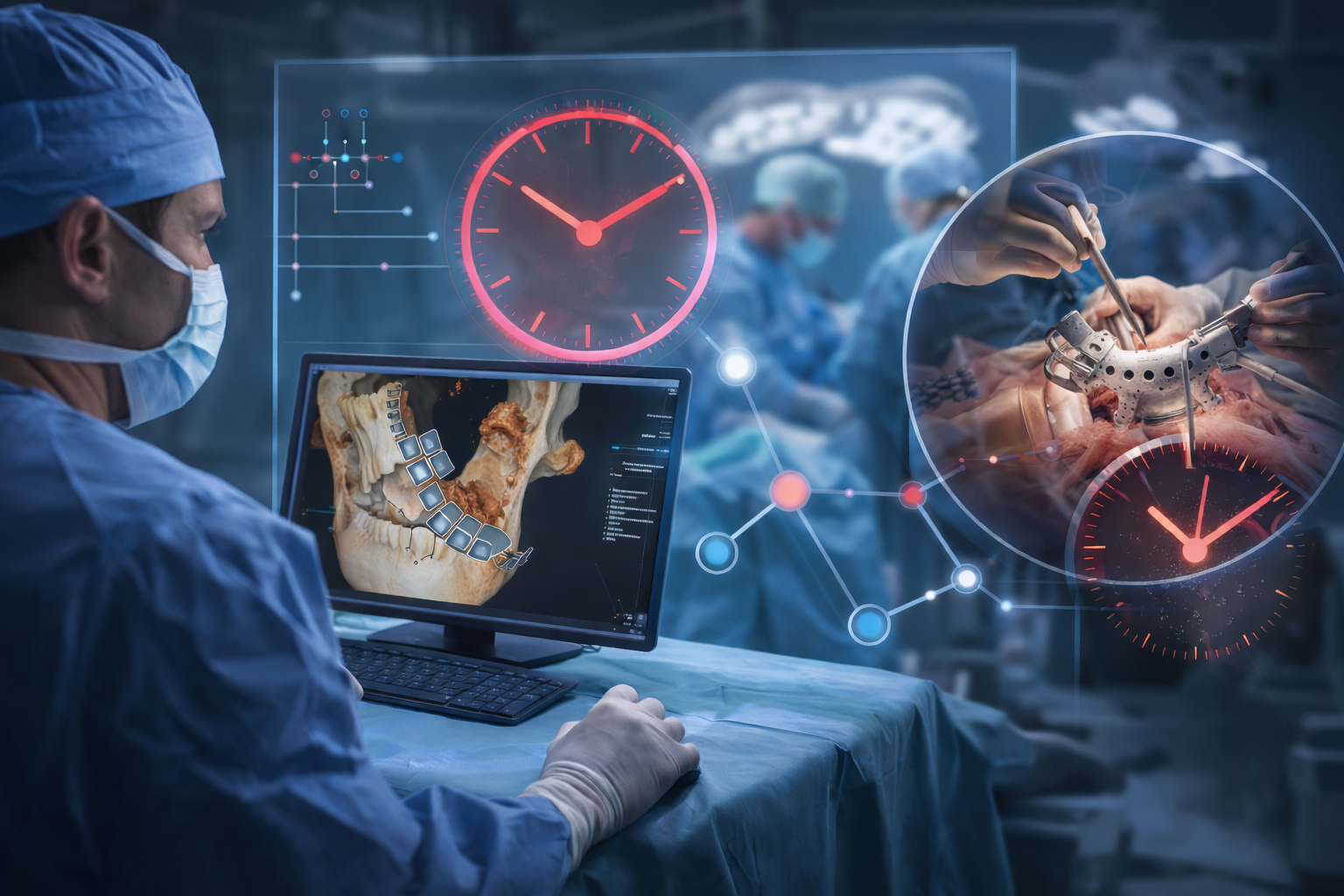
Complex surgeries test the limits of precision, coordination, and time management. Whether it is craniofacial reconstruction, orthopaedic correction, or jaw realignment, longer operating times increase surgical fatigue, anaesthesia exposure, blood loss, and postoperative complications. Over the last decade, virtual surgery planning has quietly but decisively changed how surgeons approach these challenges.
Rather than relying solely on intraoperative judgment and two-dimensional imaging, surgeons now enter the operating room with a detailed, rehearsed plan. This shift has proven to be one of the most effective ways to reduce operating time without compromising clinical outcomes.
Virtual Surgery Planning
Virtual surgery planning (VSP) is a preoperative digital workflow that allows surgeons to simulate surgical procedures before the patient enters the operating theatre. Using high-resolution CT or CBCT scans, patient anatomy is converted into a three-dimensional digital model.
This model allows surgeons to:
- Analyse anatomical complexities with greater accuracy
- Simulate osteotomies, resections, or implant placements
- Predefine measurements, angles, and movements
- Plan fixation points and hardware positioning
The result is a surgical roadmap that reduces uncertainty and decision-making during the actual procedure.
Why Operating Time Matters in Complex Surgeries?
Operating time is not just a logistical concern. It is directly linked to patient safety and outcomes.
Multiple clinical studies have shown that prolonged surgeries are associated with:
- Increased risk of surgical site infections
- Greater blood loss and transfusion rates
- Longer anaesthesia exposure
- Higher postoperative morbidity
- Extended hospital stays
In complex procedures, time overruns are often caused by intraoperative improvisation. Virtual surgery planning addresses this exact problem by shifting decision-making from the operating room to the planning stage.
How Virtual Surgery Planning Reduces Operating Time
The impact of virtual surgery planning on operating time is cumulative. It is not one single factor, but several interconnected efficiencies working together.
1. Elimination of Intraoperative Guesswork
Traditional surgical approaches rely heavily on surgeon experience and real-time judgment. While expertise remains essential, repeated intraoperative measurements and adjustments consume valuable time.
With virtual surgery planning:
- Bone cuts are predefined
- Surgical movements are measured digitally
- Implant positions are finalised before surgery
This reduces the need for trial-and-error during the procedure, shortening operative phases significantly.
2. Precise Anatomical Visualisation Before Surgery
Two-dimensional imaging limits spatial understanding, especially in anatomically complex regions such as the face, jaw, or pelvis.
Virtual surgery planning provides a full 3D anatomical view. Surgeons can rotate, section, and analyse structures from every angle. This allows them to anticipate challenges such as:
- Asymmetry
- Nerve proximity
- Bone thickness variations
- Anatomical anomalies
When these variables are identified preoperatively, fewer surprises occur during surgery, leading to faster execution.
3. Reduced Surgical Steps Through Pre-Planning
Complex surgeries often involve multiple steps that traditionally unfold sequentially in the operating room. Virtual surgery planning compresses this process.
By finalising surgical steps in advance:
- The sequence of actions is optimised
- Redundant steps are eliminated
- Instrument selection is predefined
This streamlined workflow translates directly into reduced operating time.
Virtual Surgery Planning in Orthognathic Surgery
One of the strongest use cases for virtual surgery planning is orthognathic surgery planning.
Orthognathic procedures involve repositioning the jaws to correct skeletal deformities, functional issues, or facial asymmetry. These surgeries are inherently complex, requiring millimetre-level accuracy.
Traditional Challenges in Orthognathic Surgery
- Manual model surgery using plaster casts
- Intraoperative adjustments to achieve occlusion
- Extended time spent verifying jaw alignment
- Increased reliance on intraoperative splints
Each of these steps adds time and variability.
Role of 3D Orthognathic Surgery Planning
3D orthognathic surgery planning replaces manual planning with a digital workflow that integrates imaging, occlusal analysis, and surgical simulation.
Using VSP, surgeons can:
- Simulate maxillary and mandibular movements digitally
- Assess soft tissue response to skeletal changes
- Design patient-specific surgical splints
- Predefine fixation strategies
Clinical studies have shown that 3D orthognathic surgery planning can reduce operating time by 20–30% compared to conventional methods, primarily by reducing intraoperative adjustments and verification steps.
VSPs Reduce Operating Time
Several peer-reviewed studies support the time-saving benefits of virtual surgery planning.
- A systematic review published in the Journal of Oral and Maxillofacial Surgery reported significant reductions in operative time for orthognathic surgeries planned using VSP compared to traditional planning.
- Studies in craniofacial reconstruction have demonstrated operating time reductions ranging from 15% to 35%, depending on case complexity.
- Orthopaedic applications of VSP have shown decreased fluoroscopy time and faster implant placement.
While results vary by specialty, the trend is consistent: preoperative digital planning shortens surgery.
Impact on Surgical Team Coordination
Operating time is influenced not only by the surgeon but by the entire surgical team.
Virtual surgery planning improves coordination by:
- Aligning surgeons, anaesthetists, and nurses around a shared plan
- Reducing delays caused by unexpected intraoperative decisions
- Allowing instrument trays and implants to be prepared in advance
When everyone knows the plan, transitions between surgical steps become faster and smoother.
Reduced Anaesthesia and Improved Patient Safety
Shorter surgeries mean reduced anaesthesia exposure. This is particularly important for:
- Elderly patients
- Medically compromised patients
- Long reconstructive procedures
By reducing operating time, virtual surgery planning indirectly contributes to better postoperative recovery and fewer complications.
Economic and Operational Benefits for Hospitals
From a hospital management perspective, reduced operating time has measurable operational benefits:
- Improved operating room utilisation
- Ability to schedule more cases per day
- Reduced overtime costs
- Lower complication-related expenses
Virtual surgery planning therefore supports both clinical excellence and operational efficiency.
Limitations and Responsible Use
While virtual surgery planning is powerful, it is not a replacement for surgical skill. Its effectiveness depends on:
- High-quality imaging
- Accurate segmentation and planning
- Surgeon involvement in the digital workflow
VSP is best viewed as a decision-support tool. When used responsibly, it enhances outcomes and efficiency. When over-relied upon without validation, it can introduce errors.
The Future of Virtual Surgery Planning
As software, imaging, and 3D printing technologies evolve, virtual surgery planning is becoming more precise and accessible.
Future developments include:
- AI-assisted planning suggestions
- Faster planning turnaround times
- Integration with patient-specific surgical guides
- Broader adoption across surgical disciplines
What was once limited to specialised centres is now becoming a standard of care for complex surgeries.
Conclusion
Virtual surgery planning has fundamentally changed how complex surgeries are approached. By shifting critical decisions to the preoperative phase, it reduces uncertainty, shortens operating time, and improves surgical efficiency.
In areas like orthognathic surgery planning and 3D orthognathic surgery planning, the impact is especially clear. Less time in the operating room does not mean rushing. It means operating with clarity, confidence, and precision.
In modern surgery, preparation is no longer just important. It is measurable, digital, and time-saving.